The Sabin Center’s Deputy Director Romany Webb and Climate Law Fellow Rebecca Lowy are attending the 31st Conference of the Parties to the United Nations Framework Convention on Climate Change in Antalya, Turkey in November 2026. They will be posting a series of blogs with reflections from the meeting. This is the second in the series. The first is available here.
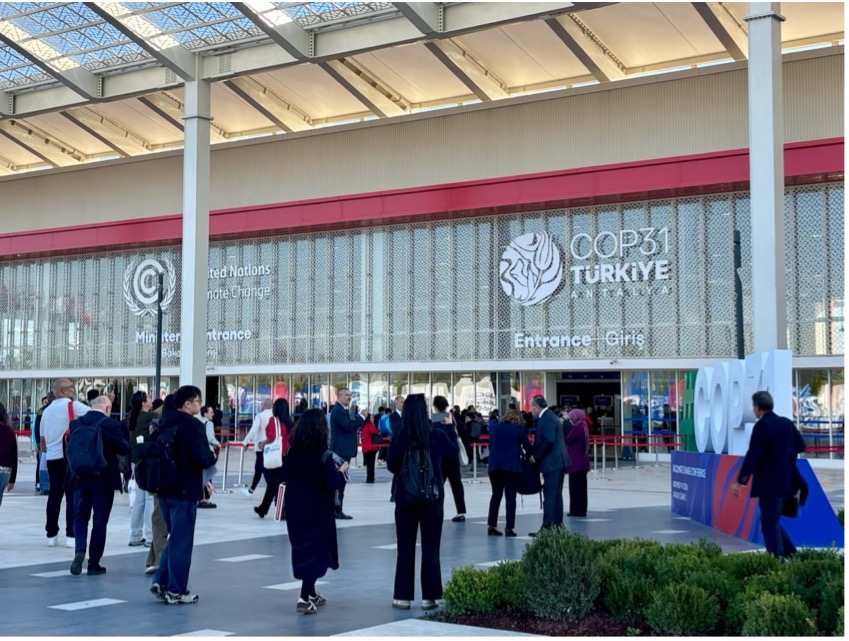 For the last several days, I’ve been Antalya, Turkey, representing the Sabin Center at the 31st Conference of the Parties (COP) to the United Nations Framework Convention on Climate Change (UNFCCC). The conference is now in its second week. Wednesday’s negotiations are coming to a close and the parties have just two days left to wrap up their discussions, with the conference scheduled to end on Friday, November 20. The COP31 President has urged all working groups to finalize draft texts as soon as possible and, ideally, today. The same message—”finish today”—was also given yesterday but, as is often the case at COPs, things aren’t running quite to schedule. Sitting in on the negotiating sessions today, it was clear that the parties were a long way from final agreement on several important points. This blog post reviews key aspects of the negotiations that have proved particularly contentious—most related, unsurprisingly, to who will cover the costs of addressing climate change and the damages it causes. I’ll post an update on whether and how these issues were resolved following conclusion of the meeting.
Adaptation: Adaptation finance has emerged as a particularly contentious issue at COP31. The African Group of Negotiators had called for the establishment of a separate negotiating track on adaptation finance, but that proposal failed to achieve consensus at the opening plenary last week. Stil, adaptation finance has been the subject of much discussion over the last week and a half, as it was at COP30 last year. The decision on adaptation adopted at COP30 called “for efforts to at least triple adaptation finance by 2035.” But it didn’t specify the starting amount that would be tripled. The parties are now trying to figure that out. Back in 2021, at COP26, developed countries agreed to at least double their collective provision of adaptation finance from 2019 levels by 2025 (to roughly $40 million annually). Developing countries now insist that there must be a “tripling of the doubling.” In line with this, the COP32 Presidency published a draft decision on Monday (November 16), which stated that adaptation finance should reach “at least $120 million” by 2035. But, following intense push back from the European Union and others, that number was left of an updated draft published early on Wednesday (November 18). The updated draft outlines three options for text on adaptation finance: one that would “urge[] developed country parties to significantly scale-up contribution to the Adaptation Fund,” a second that would “underscore[] the urgency of scaling up financial resources,” and a third that would merely “encourage[] efforts to ensure the long-term sustainability of the Adaptation Funds.” But even these watered-down versions have received push back from developed countries, with some saying they won’t agree to any of them.
Another issue that has arisen in the discussions around adaptation relates to how to address the risk of overshooting the 1.5oC temperature target set in the Paris Agreement. The Limiting Overshoot report, published by the United Nations Environment Program in September, concluded that “global action to cut greenhouse gas emissions has not been fast enough to avoid global warming crossing 1.5oC above pre-industrial levels in the next few years.” A draft decision published by the COP31 Presidency on Monday recognized that overshoot would “further increase adaptation needs” which would grow with “every increment of warming.” This language was opposed by the EU, which asserted referencing warming increments would amount to renegotiating the Paris Agreement. A similar argument was made by the Independent Association of Latin America and the Caribbean (AILAC) and Alliance of Small Island States (AOSIS) negotiating groups. The latter said its members would not accept any approach which treated 1.5oC as merely a tool for “planning” and declared that 1.5oC is the “Paris Agreement temperature goal … and it has no increments.”
Loss and damage: At COP27 in Sharm el-Sheikh, Egypt, in 2022, the parties to the UNFCCC and Paris Agreement established a new Fund for Responding to Loss and Damage. The basic idea was to provide funding for developing countries to help them address climate impacts that cannot be avoid through mitigation or adaptation. (For more on the establishment of the fund, see this prior Climate Law blog post.) The Fund is led by a Board, which comprises representatives of 26 parties to the UNFCCC and Paris Agreement. Last year, the Board agreed to the Barbados Implementation Modalities (BIM), which establish the rules for the first phase of the Fund’s operations. $250 million was initially set aside for grants during this first phase, but that was later increased to $342 million, of which 50% was reserved for Small Island Developing States and Least Developed Countries. Requests for assistance have far exceeded even the increased amount, however. As of June 29, 2026, 119 countries had submitted 176 funding requests, totaling $2.8 billion. This has been the subject of much discussion at COP31. Developing countries have been pushing the COP to adopt a statement expressing concern about the large gap between available funding and requests, but developed countries have pushed back. They’ve also, unsurprisingly, pushed back on requests for them to increase funding for the Loss and Damage Fund. A draft decision published late Tuesday (November 17) included a statement that the COP “[r]ecognizes the importance of adequate and predictable resources for the Fund, and encourages continued efforts to scale up the Funds resources.” In negotiations the following morning, developing countries argued that this must be revised to expressly acknowledge the obligation of developed countries to provide funding. Some, including the Arab Group, even went so far as to describe this as a “red line” and indicated that they would not agree to any text that omitted such a statement. But the developed countries in the room were equally adamant that they should not be singled out.
There was a similar division between developed and developing countries as to whether to say anything about the need for “rapid disbursement” of funds following emergencies. This is top of mind for many following the Nepal flood earlier this year. While the Loss and Damage Fund announced in October (already 2 months after the flood) that it had provisionally set aside $21.6 million for Nepal—well below the estimated $4.7 billion in damages suffered—the money is not expected to be disbursed for several more months. To avoid similar issues in the future, several developing countries have called for the establishment of a “rapid disbursement” mechanism, but that’s been resisted by developed countries, who argue that if the COP were to direct or even encourage such action, that would amount of “micromanagement” of the fund. Developing countries are not backing down, however, with China and others saying on Wednesday that they would not accept any decision that didn’t address this issue. At the conclusion of discussions, the co-chair of the negotiating track remarked that the room remained “quite divided” on this and other issues, and it was difficult to see a path forward.
Mitigation Ambition: At COP26 in 2021, the parties to the Paris Agreement agreed to “establish a work programme to urgently scale up mitigation ambition and implementation in this critical decade.” This was operationalized the following year via the Sharm el-Sheikh Mitigation Ambition and Implementation Work Programme, which the parties agreed would run from 2022 through 2026, and involve “at least two global dialogues [to] be held each year” to facilitate “focused exchanges of views, information, and ideas” on ways to increase mitigation ambition. Over the past week and a half at COP31, the parties have been debating whether to extend the work programme and on what terms. There is broad support for continuing the work programme through 2030, but the parties have been unable to agree on much else. Among other things, there has been disagreement on what should be reported as the key outcomes of past global dialogues, and how future dialogues should be approached. Some countries, including Egypt, Korea, and Russia, have supported moving to one global dialogue per year but this has faced pushback from others, including the AILAC negotiating group, which has argued that it represents backsliding. There has also been debate about how topics for the global dialogues should be set, with some countries arguing that this should be negotiated amongst the parties, but others suggesting this may be unworkable and that topics should instead be set by the Subsidiary Body for Scientific and Technological Advice and Subsidiary Body for Implementation.
Article 6: Article 6 of the Paris Agreement recognizes that parties may “choose to pursue voluntary cooperation” on climate change mitigation and adaptation. To this end, Article 6(2) authorizes countries to trade so-called “internationally transferred mitigation outcomes,” reflecting greenhouse gas emissions reductions or removals. How to pay for the institutional architecture required to support this, including the new Article 6(2) registry that was announced here yesterday, has been the subject of much debate. Earlier this week, Switzerland described the issue as requiring “urgent” attention, but noted that the parties were not close to agreement. Some, including the African Group of Negotiators and Like-Minded Developing Countries (LMDCs) group, have argued that funding should come from the core budget of the UNFCCC. Others see this as inappropriate as the use of Article 6(2) is voluntary. The EU proposed that costs be shared amongst countries that elect to use Article 6(2) and that proposal was supported by AOSIS, but it also called for fee waivers for small island developing states. Others said all developing countries should be exempt, otherwise “participation [in Article 6(2) could] depend on ability to pay.”
Funding for the Paris Agreement Crediting Mechanism (PACM) created in Article 6(4) of the Paris Agreement has also been discussed at COP31. While the PACM is ultimately intended to be self-financing, the volume of trades is currently too small to enable that, and current funding is expected to run out in 2027. This has led to calls (e.g., from the LMDC group) for voluntary contributions but no one seems particularly eager to step up.
* * * *
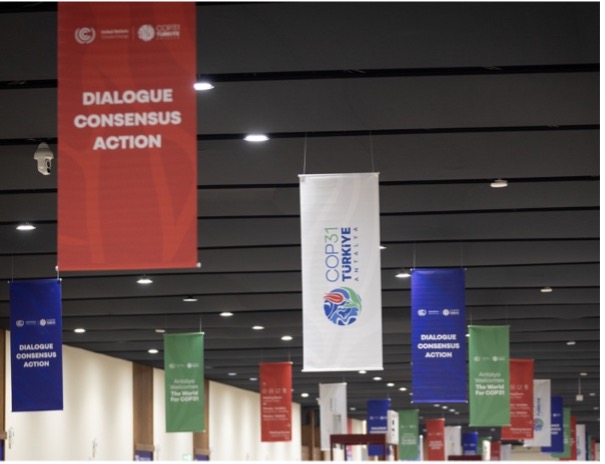
It remains to be seen whether the parties can reach common ground on these and other issues within the next two days. All around the conference venue are signs calling for “dialogue, consensus, action” but the parties are quickly running out of time to deliver that.

Romany Webb is a Research Scholar at Columbia Law School, Adjunct Associate Professor of Climate at Columbia Climate School, and Deputy Director of the Sabin Center for Climate Change Law.