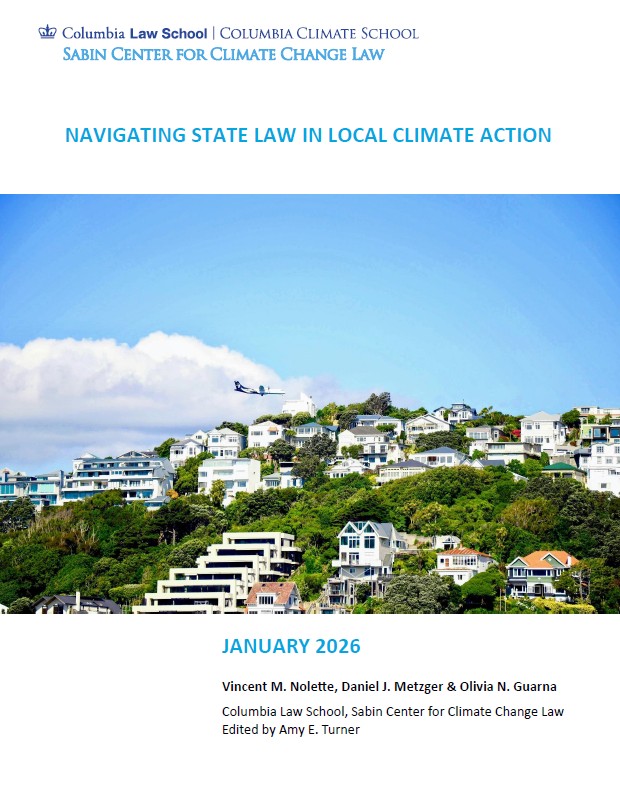
Local governments are leaders in the fight against climate change: they reduce community-wide greenhouse gas emissions, promote renewable energy resources, and otherwise advance climate mitigation and adaptation goals. But even as many local governments have already demonstrated their capability to tackle the climate crisis, state governments can hinder those efforts by preempting local laws.
Today, the Sabin Center for Climate Change Law’s Cities Climate Law Initiative (CCLI) released Navigating State Law in Local Climate Action, a report providing state-by-state information, resources, and analysis to unpack how nineteen states navigate key state-local preemption issues. Alongside the report we are launching a set of online State Toolkits to help practitioners, researchers, and city staff access critical information about local climate law and state preemption in each of the nineteen states covered. Together, the report and online toolkits are intended to serve as a primer on state preemption of local action for each of the states, with particular attention to climate considerations.
The form and extent to which states delegate power to local governments varies significantly, but most municipalities exercise at least some autonomy, especially over matters pertaining to “local affairs.” Still, local governments taking action on climate change must be aware of and act consistently with state law that can limit their authority. State law prevails—even in states where local governments are granted robust legal authority—when state law expressly preempts local actions, occupies an entire field of regulation, or conflicts with a local law.
While state law has always preempted certain local actions, over the past two decades some state legislatures have become increasingly aggressive in using preemption to enact sweeping statutes to bar local regulations. This trend, sometime referred to as “New Preemption,” is characterized by aggressive, reactionary, and deregulatory action against larger, often progressive cities—either to prevent the enactment of certain ordinances or to retaliate against those already passed. Consistent with this trend, more state governments are seeking to preempt local climate-related actions.
But local governments are not left without options. How and to what extent states succeed in preempting local action depends on specific circumstances and varies significantly by state. In every case, avenues remain open to cities, towns, and villages seeking to mitigate and adapt to climate change. Today’s report and website launch highlights the landscape within which those actions can take place in the following nineteen states: Alabama, Arizona, Florida, Georgia, Louisiana, Massachusetts, Michigan, Mississippi, Missouri, New York, North Carolina, Ohio, Oregon, Pennsylvania, South Carolina, Tennessee, Texas, Virginia, Wisconsin.
For each state covered, the full report as well as each individual state’s toolkit highlight the sources of local authority to regulate and the limits imposed by the state, including:
- Constitutional and statutory delegations of home rule authority and police powers to local governments;
- State law governing the nature and content of home rule charters, as well as preemption of local law generally;
- A catalog of current state laws that may preempt local climate action;
- Leading case law on home rule and preemption of local law;
- Where applicable, information on recent and ongoing litigation;
- A summary of how the state handles building codes;
- Discussion of legal considerations related to energy utilities;
- Helpful secondary sources; and
- Additional relevant information.
This resource is intended to help local governments, policymakers, city attorneys, academics, advocates, and other stakeholders craft resilient climate policies, anticipate and respond to preemption challenges, and mobilize public engagement. By better understanding the ways in which each of these states delegates authority to cities, local governments can more readily assess their options for responding to climate change and the legal authorities under which they may defend measures they have already taken. Clarifying the extent to which climate-specific preemption laws have already been adopted enables advocates to consider what other options may be available to cities concerned with climate change’s effects. And studying the patterns and themes that emerge across multiple states’ preemption legislation allows academics, policymakers, and other stakeholders to more broadly understand the landscape of local preemption law as it stands today.
The full report, as well as individual chapters focusing on each of the states above, is available to download here. The online toolkits with searchable pages for each of the states covered are available here.

Vincent M. Nolette is the Sabin Center's Equitable Cities Climate Law Fellow.

Dan Metzger is a Senior Fellow with the Cities Climate Law Initiative at the Sabin Center for Climate Change Law at Columbia Law School.

Olivia Guarna is the Climate Justice Fellow at the Sabin Center for Climate Change Law at Columbia Law School.

Amy Turner is the Director of the Cities Climate Law Initiative at the Sabin Center for Climate Change Law at Columbia Law School.