 Climate advocates may hope to see dramatic commercial breakthroughs over the next several decades that reshape emissions-intensive components of our everyday lives, such as our dietary choices, household energy use, and transportation habits. Yet transforming these consumer sectors will require not only scientific ingenuity and entrepreneurial ambition, but also nimble competition policy to address complex market dynamics. Sustainable economic transitions require corporations to develop cleaner products, and shoppers to select these over dirtier options. But market bottlenecks, often tied to anticompetitive practices by dominant firms, can stall urgently needed industry overhauls.
Consider sustainable proteins. Agricultural production currently generates about one-third of global greenhouse gas emissions (“GHGs”). Animal livestock account for the largest share, while occupying roughly 40% of the Earth’s habitable land, much of which could otherwise offer greater GHG-absorption opportunities. Alternative-protein products, such as soy burgers or animal-free egg whites, can thus play a pivotal role in climate change mitigation, while also promising notable benefits in animal welfare, national food security, supply-chain resiliency, long-term human health, food safety, and pandemic prevention (via reduced antibiotic usage). Widespread adoption of these protein sources, however, must overcome multiple obstacles.
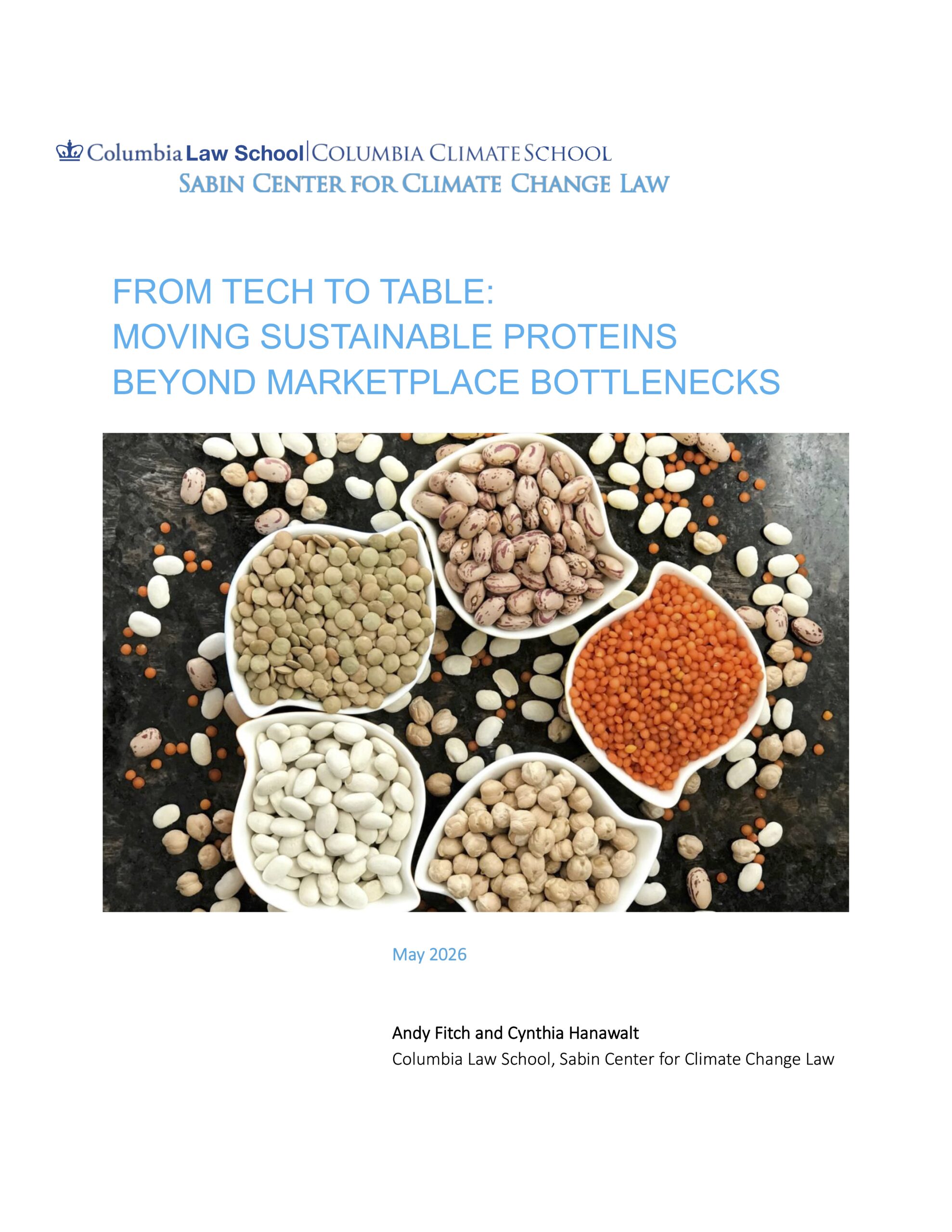
A new white paper published today by the Sabin Center for Climate Change Law explores obstacles to competition in the alternative-proteins markets, and how carefully calibrated policy choices could help overcome them. It is the first installment in a series probing where such anticompetitive pressures have arisen across emerging sectors crucial for addressing our climate crisis. While a range of products make up today’s alternative proteins sector, including plant-based proteins and lab-grown meat cultures, a core challenge for both climate and competition policymakers stands out: how to nurture “green shoots,” without unleashing market-trampling “green giants”?
Key findings of the paper include:
Horizontal consolidation can protect traditional-protein incumbents like meat processors against upstarts with better product offerings. Recent antitrust litigation showcases meat processors’ “coordinated effects” capacity to fix prices and wages. Recent academic and competition-policymaker analysis also offers the useful bio-tech analogy of pharmaceutical giants’ “killer acquisitions” to fend off disruptive drug innovations. For consolidation concerns in the alternative-proteins sector, competition-policy offices should apply antitrust scrutiny as elaborated in the FTC’s 2022 Section 5 policy statement and the 2023 Merger Guidelines, regarding cumulative-effects analysis, potential-competition analysis, and innovation markets.
Vertical consolidation can provide gatekeeping leverage, via control over competitors’ access to critical business resources. Market chokepoints in alternative-protein supply chains include: dual-role upstream commodity suppliers that simultaneously operate as downstream retail competitors; cost-prohibitive R&D or product-scaling challenges; a scarcity of pilot-project lab infrastructure; and commercial-distribution norms that preference incumbents. China, the European Union, and other nations have become more effective than the U.S. at alleviating such private-marketplace asymmetries through public funding and sector-wide support, offering a range of models for U.S. competition policymakers to consider.
Aggressive intellectual-property (“IP”) approaches disincentivize potential innovators from entering the alternative-proteins field. “Patent thicket” strategies, in which a firm systematically files to protect tangential facets of its primary technology, can leave competing ventures highly susceptible to litigation risk. Alternatively, food-sector trade secrets, for example related to cultivated meat’s pivotal cell lines, can constrain a technological breakthrough from catalyzing market-wide growth. Recent FTC investigations of anticompetitive pharmaceutical patent filings provide a fitting precedent for equivalent scrutiny in alternative proteins. At the same time, “open-access” advocates provide an effective model for breaking from industry norms of siloed proprietary research.
Regulatory complexity stemming from inconsistent state laws, dual-agency federal approval processes, and divergent international regimes create further obstacles for an alternative-protein start-up. As a result, administrative costs often fortify established firms’ entrenched market clout. The alternative-proteins sector reshuffles paradigms regarding food classification, food production, and food safety and sanitation. While policymakers must address nuanced technical questions on these topics, they should strive to avoid broader marketplace scenarios in which only a small handful of firms can navigate the ever-shifting political tides or clear the latest bureaucratic hurdles.
Just-transition frameworks are essential to navigating the economic and political fault lines threatening to constrain protein markets’ transformation. Animal-proteins incumbents may prefer to capture, rather than curtail, this growing sector. But anti-alternative-proteins policy agendas do include genuine efforts to support agricultural laborers and suppliers who are acutely vulnerable to capital- and tech-intensive market dynamics. Whole demographic swathes of the country should not be blamed for emissions-intensive traditional livestock practices. Agricultural communities should be assisted in finding stable footing amid foundational economic change.
While antitrust litigation and enforcement remain largely speculative in these nascent industries, precedents from other sectors provide a helpful framework for anticipating anticompetitive conduct in alternative-proteins markets. This conduct may include cognizable antitrust violations where incumbents seek to maintain the dominance of their established product lines, dictate the pace of innovation, or deter would-be rivals from entering the market. Expansive acquisition strategies by the largest meat processors such as JBS likely warrant enhanced M&A scrutiny, and opaque supply-chain practices by sprawling food giants such as Cargill call for further mappings of potential market gatekeeping. Anticompetitive effects can also arise when a successful first-mover locks up crucial resources and customers so competitors cannot gain market share, as may be evinced by Impossible Foods’ sector-leading patent filings, or David Protein’s refusal to deal with competitors (arguably dependent on its essential business resources). Our new paper offers competition-policy frameworks for scholars, lawyers, and government agencies to draw upon in pursuit of robust alternative-proteins markets, and urgently needed climate action.
Read the full white paper on Columbia Law School’s Scholarship Archive here.

Andy Fitch is a Climate and Business Law Fellow at the Sabin Center for Climate Change Law at Columbia Law School.

Cynthia Hanawalt is the Director of Climate and Business Law at the Sabin Center for Climate Change Law.