 In the past several years, data centers have rapidly proliferated in communities around the country and have come to dominate political discourse at every level of government. Developers highlight tax revenue that data centers can generate and the jobs they bring. The President regularly argues they are necessary for economic development and national security. But increasingly, residents of communities where data centers are proposed are voicing opposition to these projects, and calling on elected leaders to do more to regulate data centers’ impacts. Communities affected by large data center projects are raising concerns about the massive demands that hyperscale data centers have for energy and water, the potential for resulting emissions and affordability impacts, the noise and heat that they can produce, and the secrecy that some data center developers have maintained by pressuring officials to sign non-disclosure agreements.
State-level responses to data centers are mixed. Over the past several months, some have begun responding to residents’ concerns by trying to slow the pace of development and create space to study data centers’ effects and the best ways to regulate them. New York and Texas, for example, have both recently taken steps to pause new data center development—although these pauses vary in approach and are limited in scope. The governors of Pennsylvania and Virginia have both recently signed executive orders calling for stricter guardrails around data center development. West Virginia, on the other hand, has passed legislation encouraging data center development and broadly preempting local rules that might slow it down.
Local governments have increasingly turned their attention to data centers, and hundreds have passed temporary moratoria pausing new projects as a first step toward adopting more comprehensive zoning and permitting regimes. Some cities and towns around the country have already created or updated zoning rules to tackle data centers, but many are still studying the issues and considering how best to approach this challenge.
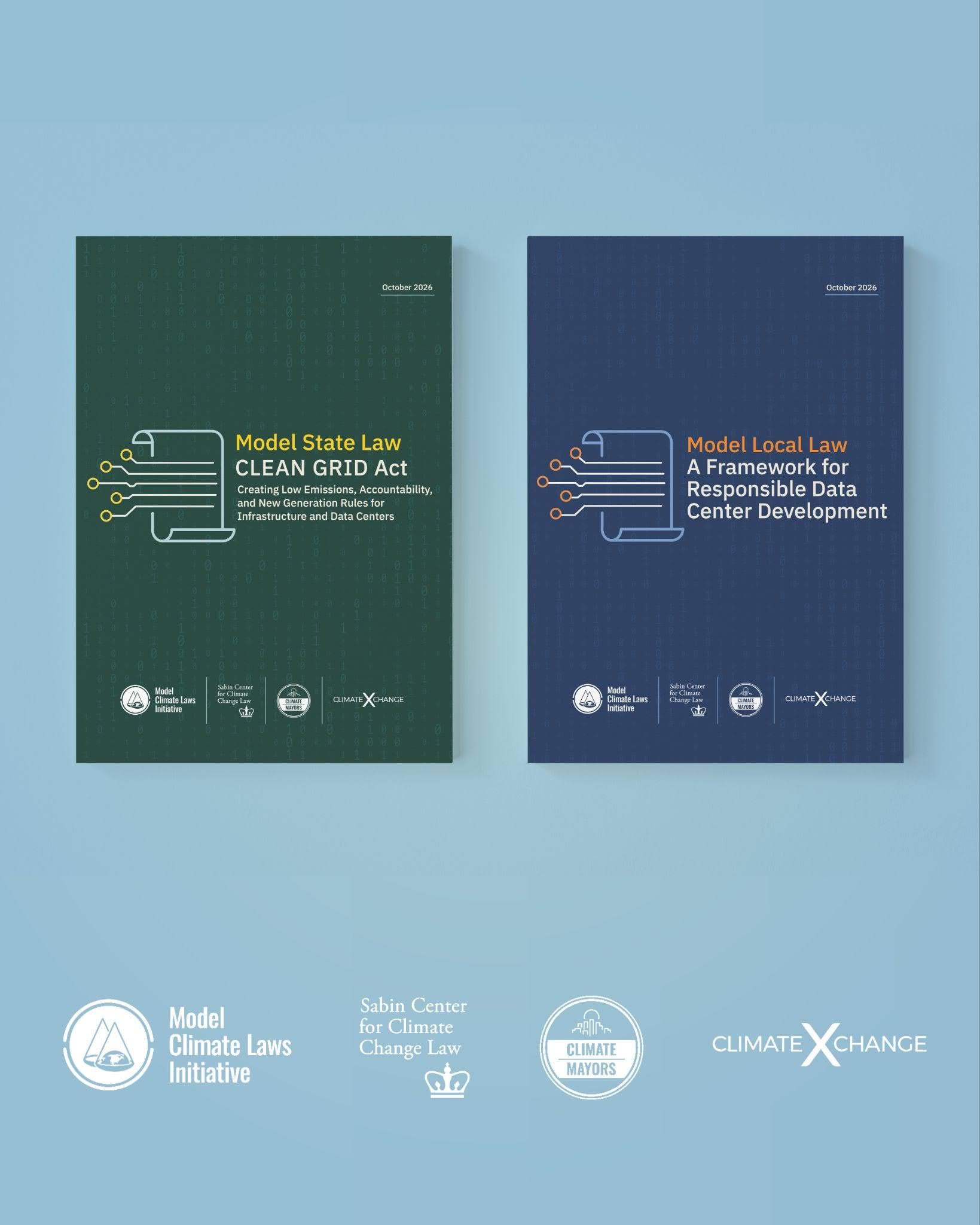
Today we are publishing two new model laws to help meet the needs of jurisdictions looking for resources to craft responses to data center development. These model laws were developed in response to dozens of requests for guidance from mayors, city staff, and additional stakeholders on how state and local governments can guard against the worst environmental impacts that data centers can bring without closing the door to their benefits. In response, the Model Climate Laws Initiative—a joint project of the Sabin Center and Environmental Advocates New York—has published Model Local Law: A Framework for Responsible Data Center Development and State Law for Data Centers – Creating Low Emissions, Accountability, and New Generation Rules for Infrastructure and Data Center (CLEAN GRID) Act. The models draw heavily on research and input from the Sabin Center’s Cities Climate Law Initiative, Climate Mayors, and Climate XChange.
The two model laws tackle several of the same impacts using different regulatory mechanisms, and are not intended to be mutually exclusive. Some provisions are similar or overlapping across the two model laws, recognizing the different authorities and approaches of state- and local-level governments. Each is designed to be a modular, customizable resource that can serve as a template and starting point for state and local governments that expect new data centers, are engaging with developers, are seeing new facilities come to neighboring areas, or simply want to better understand the landscape of regulatory responses to data center development.
Model State Law
The model state law empowers states to require data centers to mitigate their emissions and facilitates information gathering and government studies that will pave the way for any additional regulatory action needed in the future to to minimize data centers’ impacts . It is framed around several key provisions:
- Certificate of Operation. The primary mechanism set out in the model law is a newly created “Certificate of Operation,” which a data center developer must obtain and which will only be issued when their project complies with all the environmental and other requirements that the state sets for data center construction and operation.
- “Bring Your Own New Clean Energy” (BYONCE). Data centers certified under this model law will be required to provide new, additional clean energy to satisfy their own load, including by utilizing energy storage and other distributed energy resources, like virtual power plants. The model law grants a state’s public utility commission authority to conduct rulemaking and ratemaking proceedings that may be necessary to carry this out. Implementing BYONCE requirements minimizes both the emissions and affordability impacts of data center development, because developers are required to pay for their own generation and infrastructure.
- Backup Power. Data centers are required to use nonemitting sources of backup power to the extent technically feasible—and where that is not feasible, they must maximize the efficiency of emitting sources and minimize their hours of operation.
- Transparency. The model law forbids using nondisclosure agreements in the project permitting process, and requires disclosures of project impacts and community consultation.
- Data Center Planning Commission. The model law creates a Data Center Planning Commission charged with reviewing the impacts of data center development across the state and making legislative or regulatory recommendations. The Commission created under this law would identify opportunity zones where data centers might take advantage of technical opportunities to support clean energy and energy efficiency, such as by serving a thermal energy network, utilizing surplus interconnection capacity, or filling a transmission need.
Model Local Law
The model local law gives local governments a state-of-the-art example drawing on academic legal research and real-world examples to guide responsible data center development. It is organized around four key regulatory tools:
- Zoning. Under the model ordinance, data centers can be built only in designated zoning districts and only with a special permit. Permit applicants must notify nearby residents and elected officials, and must publicly share information on their projects’ water and energy use and noise.
- Operational Requirements. Data centers approved under the model ordinance will use 100% renewable energy, storage, or clean distributed energy resources, and must comply with limits on their water use, mitigate their impact on ambient noise levels, and help meet local climate goals with cool roofs and walls, low-carbon concrete, bird-friendly glass, and limits on fossil-fuel backup generators.
- Transparency. Secret deals are not possible under the model ordinance, which forbids non-disclosure agreements with data center developers, and also requires developers to disclose their project’s water use, effect on ambient noise, and their for how to obtain the energy that will power a data center, including their power purchase agreements and anticipated grid impacts.
- Community Benefits. In addition to complying with the siting, operational, and transparency requirements, under this model ordinance, each developer must also enter into a community benefits agreement that meets specified minimum standards before a project can be approved. This helps to level the playing field in negotiations between developers and municipalities, and ensure that local residents realize the benefits of projects in their communities.
* * *
States, local governments, community groups, and other stakeholders concerned about data center development are often under pressure to act quickly, and they are eager to see limits placed on the environmental consequences that data centers can bring. But regulators in many communities do wish to welcome data centers so that they do not lose access to the revenue and jobs that new industries can bring. These new model laws provide a resource for striking that balance by allowing for responsible data center development within clear, predictable boundaries that protect communities.

Jon Binder
Jon Binder is the Executive Director of the Model Climate Laws Initiative and a Non-Resident Senior Fellow at the Sabin Center.

Daniel J. Metzger is the Director of the the Cities Climate Law Initiative at the Sabin Center for Climate Change Law at Columbia Law School.