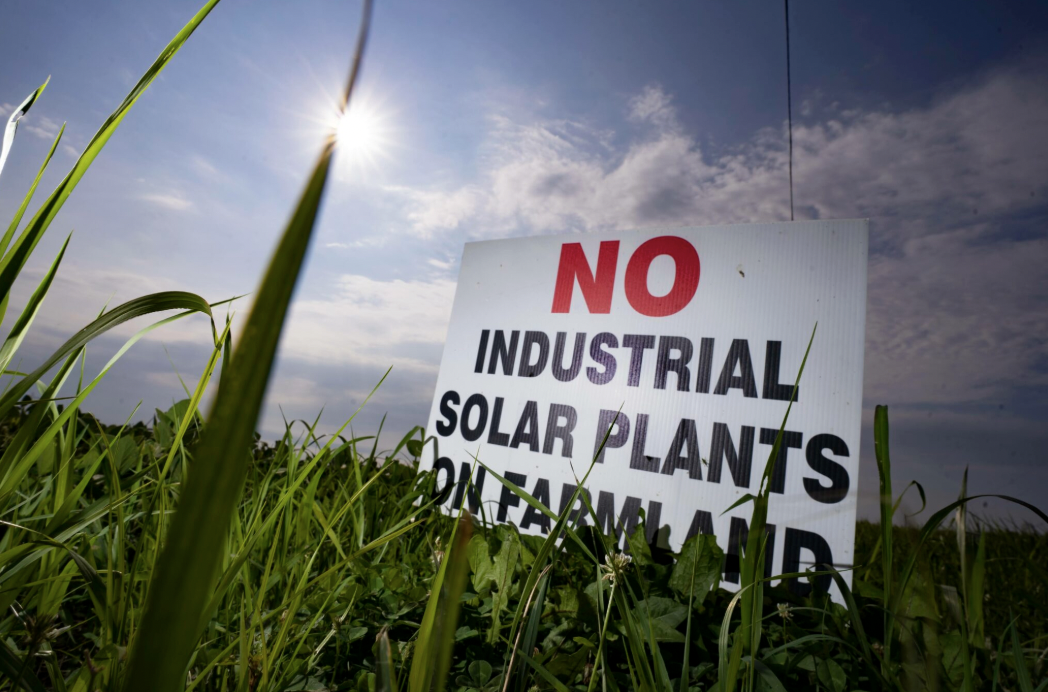
New York’s Office of Renewable Energy Siting (ORES) has generated opposition from rural and agrarian communities where renewable energy infrastructure is proposed. Some of that opposition is fueled by misinformation about the impacts of renewable energy projects on wildlife, farmland, and property values, among other issues. This blog rebuts three of the most common misconceptions about renewable energy development in New York, which are also addressed in a recently published Sabin Center report: 38 False Claims About Solar, Wind, Electric Vehicles, and Battery Storage.
Legal Background: The Office of Renewable Energy Siting
In 2020, New York passed the Accelerated Renewable Energy Growth and Community Benefit Act (AREGCBA), creating ORES. The legislature created ORES, in part, to accelerate renewable energy development and reduce the regulatory uncertainty impeding the State from meeting the greenhouse gas emission reduction targets set under the Climate Leadership and Community Protection Act (CLCPA). To this end, AREGCBA established a new centralized state siting process for major renewable energy facilities, standardized permitting requirements and timelines, and gave ORES the authority to override conflicting local laws.
The State did not, however, preclude local involvement in the state siting process. On the contrary, the AREGCBA provides several opportunities for local communities to participate in decision-making. Renewable energy project developers must consult with the municipality where their projects will be built before filing a permit application. Local governments may then submit comments and participate in ORES proceedings, and “substantive and significant issues” ⎯ i.e. issues which create “sufficient doubt about the applicant’s ability to meet statutory or regulatory criteria applicable to the project ”⎯may be addressed through agency adjudication. ORES must also consider applicable local laws and may only override those laws if they are “unreasonably burdensome in view of the CLCPA targets and the environmental benefits” of the project. The centralized process thus maintains avenues for local participation and influence.
In enacting AREGCBA, the legislature sought both to streamline permitting and to reduce development risk. On permit streamlining, AREGCBA requires ORES to make a final decision within one year of receiving a complete permit application. A 2024 State Comptroller audit found that “while the overall time between application and [issuance of a] final siting permit has improved since the creation of ORES, the process has taken significantly longer than originally envisioned because certain aspects of the process were not considered.” The Comptroller reviewed 14 projects that received siting permits under AREGCA and found that “it took an average of 1,094 days (3 years) to deem the application complete – the longest part of ORES’s process – and, overall, an average of 1,337 days (3.7 years) from the initial application date to the date the final siting permit was issued.” This is, however, still shorter than the average permitting time (4 to 5 years) under the previous Article 10 regime. Moreover, since much of the delay in the AREGCA process is due to developers submitting incomplete applications, permitting timelines should improve as developers gain experience with ORES’ requirements. Additionally, ORES provides considerable development certainty: since 2020, it has authorized thirty-six renewable energy projects and denied only two (an approval rate of approximately 94.7%).
The Controversy: Upstate Opposition and Renewable Energy Misinformation
ORES’ approval of renewable energy projects in upstate New York has often generated backlash. Some residents and local officials view the state’s siting process as unfair to host communities, particularly given the State’s authority to override conflicting local laws. Others fear the impacts renewable energy development may have on their communities. In some cases, these fears are based on valid concerns about, for example, disruptions due to construction activity, road damage from an increase in truck traffic, and the like. Others, though, are grounded in misinformation spread by individuals or groups seeking to block development. This misinformation can include outright falsehoods, as well as exaggerated claims and misrepresentations. Studies show that, while this misinformation is often spread by what appear to be local groups, those groups are frequently supported by multinational fossil fuel interests (see here for example). Individuals who are exposed to misinformation are more likely to oppose renewable energy development, and that opposition makes projects harder to build.
In New York, specifically, misinformation about renewable energy often centers on its impacts on other land uses and the environment. Three of the most common false and exaggerated claims are discussed below.
A. Claim 1: Renewable energy development will substantially harm wildlife biodiversity.
Opponents of renewable energy development in upstate New York claim that it is destroying habitat and harming native species. The claims are often wildly exaggerated, however. For example, one opponent recently claimed that developers are “clearing all of [the grasslands, forests, and wetlands] off of the planet for [solar] panels.” That is simply untrue.
In New York, renewable energy projects use only a tiny fraction of available land, and projects are rarely sited in ecologically sensitive areas. For example, a recent study of utility-scale solar projects in the state found that they occupy just 0.05% of New York’s land area, with 48% of projects occurring on hay or pasture land and another 38% on cropland. These previously disturbed areas might provide habitat for some species, but the fact that they are in agricultural production often limits their ecological value. In any event, continued use of the land by species is not inconsistent with solar development. Many projects incorporate native vegetation and pollinator habitat, which can lead to increased plant and insect diversity. For example, the Underhill Community Solar Farm in Poughkeepsie includes nearly 20 acres of native pollinator-friendly habitat on formerly agricultural land.
Claims about the impacts of renewable energy development on species are also often heavily overstated by critics. For example, some have argued that wind turbines kill “millions” of birds but, again, that is just not the case. Research has shown that cat predation and building collisions are a much bigger threat to birds, together accounting for 3 billion mortalities annually, compared to 234,000 annual mortalities from wind turbines.
B. Claim 2: Renewable energy development will ruin prime farmland.
Opponents of renewable energy development in upstate New York often argue that it will destroy prime farmland. The New York State Comptroller has reported that the state lost 11 percent of its farmland since 2015. Critically, however, this farmland loss is not primarily due to renewable energy development, but rather agricultural market pressures and conversion of farmland for residential and commercial uses. Indeed, from 2017 to 2022, only 0.5% of total farmland loss in New York was attributable to renewable energy development. Opponents might respond by pointing to planned projects which will take up more land. But, even accounting for that, it is estimated that renewable energy projects in New York will occupy only 2.2% of the State’s total active farmland by 2040. Nationally, the projected scale of renewable energy land use is even smaller. The Department of Energy estimates that, at most, solar development is likely to require approximately 10.3 million acres of land across the U.S. by 2050. That’s roughly 1.15 percent of the 895.3 million acres of U.S. farmland.
In addition, renewable energy development and continued agriculture production are not mutually exclusive. A 2026 study of renewable energy projects across the U.S. found that “neither wind nor solar development is associated with declines in agricultural GDP, employment or wages, suggesting that renewable energy development does not substantially disrupt agricultural economic activity in rural counties.” In fact, prior research has shown that renewable energy development can actually enhance agricultural productivity, with one study finding higher corn, soybean, and hay yields near wind facilities, potentially due to local microclimate effects.
Agrivoltaics projects can combine energy generation with crop production or grazing, while providing other agricultural benefits, including reduced water consumption, erosion control, and pollinator habitat. Moreover, any development of farmland for renewables is done with the consent of the landowner. The lease payments from renewable energy projects diversify farmers’ incomes and help struggling farms remain viable, thus preserving agricultural use into the future.
C. Claim 3: Renewable energy development “destroys” property values.
Some commentators in upstate New York have argued that renewable energy development will “destroy” local property values. In fact, however, a recent study in New York found that the value of agricultural land identified as suitable for solar energy (due to proximity to substations) is typically 15 to 18% higher than comparable unsuitable land parcels. Additionally, having a solar energy facility developed on neighboring property may also increase agricultural land values.
At a national level, a comprehensive 2025 study found having a large-scale solar facility “within 2 miles of agricultural or vacant land increases the sales price per acre by an average of 19.4%.” It should be noted that the same study found that the average value of residential property within three miles of large-scale solar projects initially decreased by 4.8 percent, but values returned to their previous level within 10 years. Moreover, there was significant geographic variation, with some areas actually seeing residential property prices increase following development of a large-scale solar plant on nearby land.
Conclusion
Much of the criticism of renewable energy development in upstate New York and other agrarian communities appears to stem from a concern that such development represents a threat to the “rural way of life.” That’s an understandable fear, especially given the substantial economic challenges facing farmers in many areas. It is estimated that New York lost 15% of its farms over the last decade. But this is primarily due to federal economic and foreign policy, not local renewable energy development. In fact, as the above discussion shows, renewable energy development could help to mitigate some of the economic and other challenges farmers are facing, including by providing them with a new source of income and enabling them to keep their farms in production. Unfortunately, these facts are often lost in all the misinformation opponents are spreading.

Andrew Kieffer is a Fellow with the Renewable Energy Legal Defense Initiative at the Sabin Center for Climate Change Law at Columbia Law School.