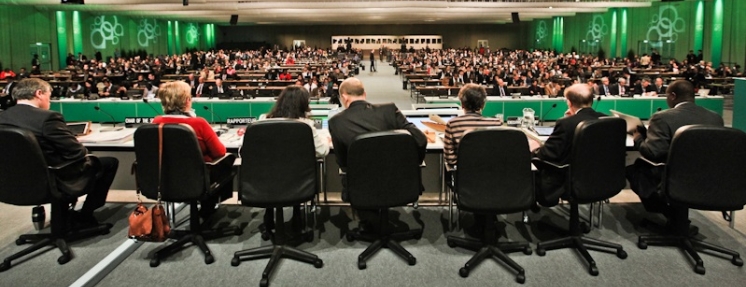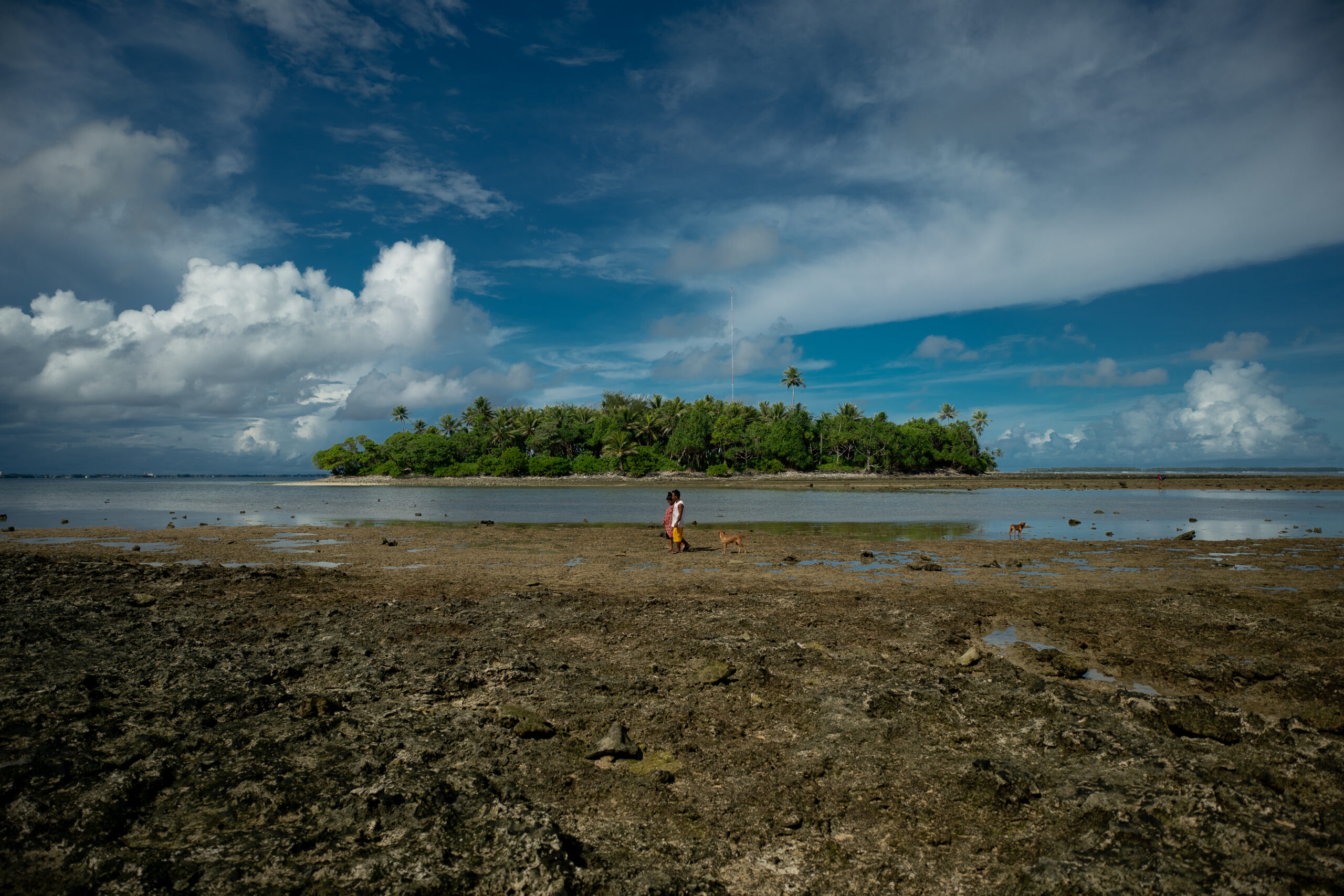
The United Nations General Assembly appears about to resolve one of the prominent legal issues caused by the sea level rise that is occurring mostly because of climate change: whether an island state that is no longer habitable because of sea level rise maintains its statehood and its UN membership. The answer is expected to be yes.
On September 24 the General Assembly is scheduled to approve a Declaration on Sea Level Rise. The declaration has already undergone extensive deliberation and appears set for consensus approval. It provides:
We recall that once a State is established, the disappearance of one of its constituent elements would not necessarily entail the loss of its statehood. We affirm the presumption in favour of continued statehood and in this respect we underscore the continuity of statehood in the face of sea level rise, as well as sovereignty, sovereign rights and responsibilities, and membership of the United Nations of such States, consistent with international law. We call for international support for States facing land territory changes due to sea level rise to continue to maintain institutional functions.
Addressing a closely related issue, the declaration also states, “We stress the need for stability of maritime zones in response to physical changes resulting from sea level rise. Once established in accordance with UNCLOS, we affirm that States can accordingly maintain their maritime zones in the face of physical changes resulting from sea level rise, without prejudice to the State’s ability to update them. We encourage the provision of relevant technical support to assist States to finalise their baselines under UNCLOS.”
These actions represent, to an important extent, the culmination of several years’ effort by the small island developing states to ensure their statehood continues even if current trends in sea level rise continue. This blog traces the evolution of those efforts. I have previously addressed here some of the scenarios under which statehood could be maintained by a state that is no longer inhabited.
Background
The 1933 Convention on the Rights and Duties of States – the Montevideo Convention – declared the requirements for the formation of a state. Only 17 states have ratified this convention, but it is the most often cited authority on state formation. It said that four features must be present:
- A permeant population
- A defined territory
- A government
- The capacity to enter into international relations
With respect to what this means for small island states — as long as any one island in the country still has a permanent population, there is little question about retaining statehood.
But after that – when there is no inhabited land left — the issue is whether these factors apply not only to the formation of a state, but also to the continuation of a state. The overwhelming sentiment in the international community ihas become that no – these four factors do not apply to continuation of a state.
Growing convergence
There have been several important recent developments that demonstrate a growing convergence around this view.
In 2023 the Pacific Islands Forum issued its Declaration on the continuity of statehood and the protection of persons in the face of climate change-related sea level rise. It recognized that “continuity of statehood in the face of climate change-related sea-level rise is consistent with important principles and rights of international law,” and it declared “that the statehood and sovereignty of Members of the Pacific Islands Forum will continue and the rights and duties inherent thereto will be maintained, notwithstanding the impact of climate change-related sea-level rise.” This declaration was subsequently affirmed by several other regional bodies.
In 2023, Australia and Tuvalu entered into a treaty that recognized Tuvalu’s continuing statehood and sovereignty, notwithstanding the impact of sea level rise. That’s the first legally binding treaty with such recognition.
In September 2024 AOSIS, the Alliance of Small Island States, issued it Declaration on sea-level rise and statehood, consistent with the Pacific Islands Forum Declaration.
In September 2024, U.S. Secretary of State Anthony Blinken issued a statement declaring that the position of the United States “is that sea-level rise should not diminish a country’s maritime zones, including the fishing grounds and resources under a nation’s jurisdiction. And no country should lose its statehood or membership in the United Nations or other international organizations because of sea-level rise.” (Secretary Blinken’s successor, Marco Rubio, does not appear to have directly addressed the issue, though he has generally opposed action on climate change.)
Also in September 2024, the General Assembly held a high-level meeting on the overall theme of “Addressing the threats posed by sea-level rise.” At that meeting, according to the co-chairs of the International Law Commission’s sea-level rise study group, “there was very broad support among States for the continuity of statehood and the preservation of maritime zones.” Likewise, the Secretary-General’s summary of that meeting reported, “While many highlighted the existential threat posed by sea-level rise, many delegations also made clear that sea-level rise is not an existential threat to statehood, reiterating the continuity of statehood and sovereignty. Loss of territory of existing States due to sea-level rise should not extinguish statehood or sovereignty.”
On March 29, 2023, the UN General Assembly adopted a resolution to request the International Court of Justice to issue an advisory opinion on state obligations regarding climate change. The questions the General Assembly asked the ICJ to address did not include one about continuity of statehood. However, 33 states and seven international organizations addressed this topic in their submissions to the ICJ. It appears that no participant contested the principle that sea-level rise does not eviscerate the legal personality of a State.
The ICJ issued its decision in July 2025. One paragraph — Paragraph 363 – addressed continuity of statehood. It said, in its entirety: “Several participants argued that sea level rise also poses a significant threat to the territorial integrity and thus to the very statehood of small island States. In their view, in the event of the complete loss of a State’s territory and the displacement of its population, a strong presumption in favour of continued statehood should apply. In the view of the Court, once a State is established, the disappearance of one of its constituent elements would not necessarily entail the loss of its statehood.”
This was a unanimous decision of the 15 judges on the ICJ; that is very unusual.
But four concurring opinions addressed statehood. Three of them explicitly endorsed the ICJ’s position and advocated for an even stronger stance in favor of continued statehood.
One of the judges, Judge Tomka of Slovakia, disagreed and suggested that the Montevideo principles do apply to continuation of statehood.
The International Law Commission had been studying sea level rise since 2019. It submitted its final report to the General Assembly in 2025. The report declared that “there is strong support among States for the continuity of statehood and sovereignty and the maintenance of international legal personality and membership of international organizations.” They reported that the Pacific Island Forum declaration and the AOSIS declaration “have received widespread support from other States and regional organizations.”
Importantly, the International Law Commission found that the continuity of statehood in the context of climate-change related sea-level rise is based on numerous rights. They listed “the right of States to preserve their existence, the right of each State to preserve its territorial integrity and the right of peoples to self-determination.” It added that continuity “is linked to legal stability, certainty and predictability, the sovereign equality of States, permanent sovereignty of States over their natural resources, the maintenance of international peace and security, equity and justice, and international cooperation.” And they said that the “continuity of statehood is essential to avoid situations of loss of nationality and statelessness.”
The ILC discussed several possible scenarios for continued statehood: ceding of a portion of territory by another State, with or without transfer of sovereignty; association with another State; establishment of or incorporation into confederations or federations; unification with another State; and possible development of hybrid or ad hoc schemes. They emphasized that the selection of one of these, or something else, would be case-by-case and would involve consultations with the populations concerned.
The co-chairs of the ILC’s Study Group on Sea-Level Rise noted that in each specific case it would be necessary to address issued related to the legal status of nationals with respect to their State of origin and their host State or State of residence, the exercise of rights by such persons, mechanisms for consultation and participation in matters involving their state of origin, the use of the state’s resources for the benefit of its nationals, and practical matters relating to the functioning of the Government in the territory of another state.
ILC final report also noted the growing international consensus on the preservation of maritime boundaries and on the protection of persons affected by sea level rise, and found that these two issues and the issue of statehood continuity “are all interconnected. The loss or diminution of one will result in the same for the others. The continuity of statehood is directly linked to preservation of maritime zones and entitlements and is integral to the preservation of existing rights, as the sovereignty of the State is the foundation for sovereign rights over natural resources.” They added, “States have an important duty in ensuring the protection of their people, and continuity of statehood is necessary and fundamental to the provision of that protection, including to prevent situations of loss of nationality and statelessness. The ability of the State to continue to fulfil its human rights obligations is, therefore also connected with the issue of continuity of statehood.”
Outlook
I’ll note that no member state has ever been expelled from the UN. The only provision of the UN Charter regarding expulsion applies to any member “who has persistently violated the Principles contained in the present Charter.” The General Assembly would need to act upon the recommendation of the Security Council. That has never happened. But UN membership is not identical to recognition by other states. Some countries are not UN members but are recognized by many states – Taiwan, Kosovo, and Palestine. And some countries are UN members but are not recognized by some states – Israel, and North Korea. So the real question is whether a state that has been submerged or otherwise become uninhabitable would be recognized as a state by other states. The overwhelming though not unanimous view of the states that have expressed a view have said that they would regard a state as continuing to exist even if climate change has made it uninhabitable.
To in sum, we have seen a convergence in the international community around a presumption that a country does not lose its statehood if its territory has become uninhabitable as a result of sea level rise. Each declaration on that subject adds to this convergence.
In April 2026 I addressed a workshop organized by the Coalition for addressing Sea level rise & its Existential Threats, held at South Korea’s UN consulate in New York and co-chaired by Germany and Tuvalu. I told the workshop, “It would be useful to definitively resolve this issue through a General Assembly resolution sooner rather than later, since if and when the time comes that every island in one of the small island states has actually become uninhabitable, sea level rise conditions around the globe will be causing crises in many large states, and it may be hard to draw attention to the plight of the small island states.” It appears that this resolution is about to come to be.

Michael Gerrard
Michael Gerrard is Andrew Sabin Professor of Professional Practice and founder and faculty director of the Sabin Center for Climate Change Law. He is former chair of the faculty of the Columbia Earth Institute and of the American Bar Association's Section of Environment, Energy and Resources. He practiced environmental law full-time in New York from 1979 to 2008, and has written or edited 14 books on environmental law.