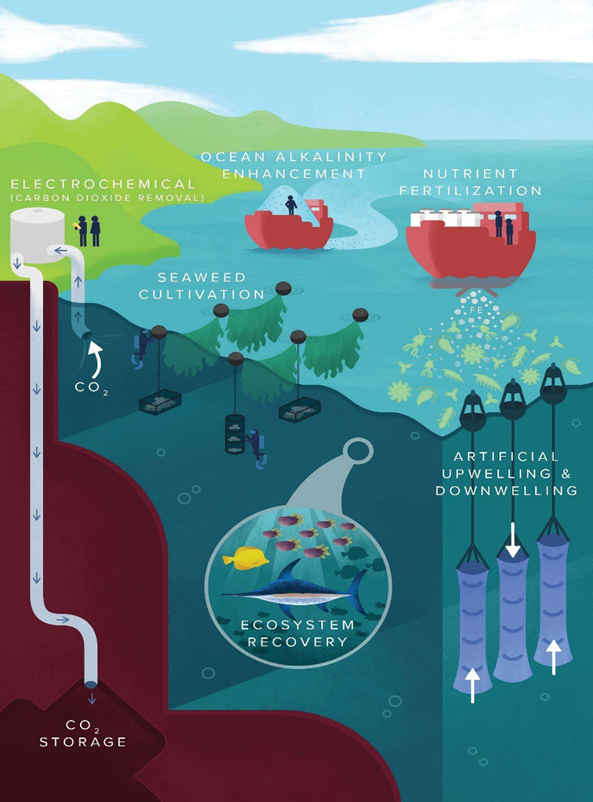
The new Limiting Overshoot report from the United Nations Environment Program (UNEP) paints a grim picture. Global warming is likely to exceed 1.5oC above pre-industrial levels within the next decade and could reach as high as 3.6oC by 2100. Still, UNEP is adamant that we must not give up on the 1.5oC target, and should work to “get onto an ‘overshoot, peak and decline pathway’ that holds temperature rise to the lowest level possible, then brings it back down by the end of the century.” To have any hope of doing that, we must rapidly and dramatically reduce greenhouse gas emissions, while simultaneously scaling up carbon dioxide removal (CDR). Recent studies suggest that we may need to remove 10 to 30 gigatons of carbon dioxide from the atmosphere each year in the second half of the century. That is a lot, especially when one considers that current CDR is just 2.2 gigatons per year. Almost all of that is from forestry projects but, as climate change intensifies, forests’ ability to store carbon dioxide will decline. Other land-based CDR is growing but also faces major challenges. That has prompted some to ask: what about CDR in the ocean? A new report published this week by the National Academies of Sciences, Engineering, and Medicine finds that ocean-based or marine CDR holds significant promise but also faces significant challenges, including due inadequate governance.
This is not the first time the National Academies has considered marine CDR. Back in 2020, the National Academies convened an ad hoc committee to study the potential for marine CDR. I was lucky to serve on that committee, along with 11 other experts from around the world. In 2022, we published the first comprehensive research agenda for marine CDR, identifying key scientific, technical, governance, and other questions that need to be answered for society to be able to make informed decisions about whether and how to move forward. In 2025, the National Academies established a standing committee to update and expand the 2022 research agenda. I have been privileged to serve on that committee, along with my Columbia colleague Galen McKinley, and others from across the United States and around the world.
On Wednesday, September 16, the committee published our initial findings. We’ve updated two key sections of the 2022 report: (1) exploring a broad range of governance considerations for marine CDR, and (2) discussing the specific marine CDR technique of ocean alkalinity enhancement (OAE). We’ve also put together a new summary of the “State of Marine CDR,” which provides a broad overview of the current status, challenges, and opportunities of marine CDR.
As detailed in these new materials, a lot has changed since the 2022 report was published. Research projects, including in-ocean field trials, have answered some important questions about the efficacy and impacts of OAE and other marine CDR techniques but notable uncertainties remain. Even so, private-sector companies have already entered the field, and begun selling carbon credits. Meanwhile, governments have been hotly debating how to approach regulation of both the research, and any future large-scale deployments. This last piece could end up having a major impact on whether and how marine CDR can be used to help mitigate climate change. Indeed, the new National Academies report concludes that “[g]overnance gaps directly constrain the near-term scalability of” OAE. I know from my own research that the same is true for other marine CDR techniques as well (see here and here, for example).
Developing a robust governance framework is important because marine CDR involves perturbation of the ocean—a global commons that all countries, and all people, have an interest in protecting. Unsurprisingly, then, marine CDR has been the subject of much discussion under existing international ocean protection regimes. Most notably, the parties to the London Convention and London Protocol—two international agreements that regulate ocean dumping—have been debating whether and how to approach different marine CDR techniques for nearly twenty-years. They have relatively little to show for their efforts, however. The parties to the London Protocol did agree on an amendment, which is intended to regulate one specific marine CDR technique – ocean fertilization—back in 2013 but it still hasn’t entered into force and so isn’t legally binding. (For more information on the 2013 amendment and other efforts to regulate marine CDR under the London Convention and Protocol, see my previous Climate Law Blog posts here, here, and here.)
There are several other international agreements that could apply to marine CDR but they were, for the most part, developed with other activities in mind. As noted in the National Academies report, many are focused “on protecting the ocean from potentially harmful human activities that could, for example, cause marine pollution or otherwise damage marine ecosystems.” This can create challenges in applying them to activities like marine CDR, which may pose risks to the marine environment, but are ultimately intended to deliver environmental benefits (i.e., in the form of climate change mitigation). Existing regimes have often struggled with how to approach these trade-offs. Moreover, there are key uncertainties and gaps in their coverage, which could hinder the development of marine CDR activities and/or undermine environmental and social safeguards.
Similar issues arise at the national level, too. The National Academies report finds that “most countries ha[ve] yet to adopt specific legal frameworks tailored to marine CDR, but [are] instead regulating it under general environmental laws, which can result in governance gaps, uncertainties, and complexities.” It includes case studies exploring the approach to regulation in China, Germany, and the United States. Germany is particularly notable because it is one of the few countries that has enacted legislation specifically addressing marine CDR. When first enacted, the legislation prohibited a wide range of marine CDR activities, but it was recently amended to allow for research into OAE and certain other techniques. Here in the United States, OAE and other marine CDR research has been permitted under existing, general environmental statutes (see here and here, for example). There is, however, a question as to whether these existing permitting pathways will remain viable if and when activities begin to scale-up.
Recognizing these challenges, the National Academies report calls for further work to “[e]valuate options for advancing … governance of marine CDR” at the international, national, and subnational levels. The report emphasizes that, across all levels, governance should be designed to support responsible research and development of marine CDR while also maintaining robust environmental and social safeguards. Unless and until this sort of governance framework is put in place, advancing marine CDR may prove impossible. That’s a real concern because, as UNEP’s Limiting Overshoot report makes painfully clear, we are going to need every tool in the toolbox if we are to have any hope of avoiding climate catastrophe.

Romany Webb
Romany Webb is a Research Scholar at Columbia Law School, Adjunct Associate Professor of Climate at Columbia Climate School, and Deputy Director of the Sabin Center for Climate Change Law.