On Thursday July 16th, a group of Sabin Center staff and summer interns boarded the shuttle from Morningside Heights to travel to the Lamont-Doherty Earth Observatory (LDEO) for an incredible day of learning about the science behind the work we do to combat the climate crisis and advance climate justice.
We were met at the LDEO campus by Trinish Chatterjee, a fourth-year PhD candidate in Earth and Environmental Sciences. Trinish hosted us throughout the day, telling our group fun facts about the LDEO campus (did you know that one building had to be painted green because the Rockefeller family estate across the Hudson River didn’t like the view?), and those who have worked there, including Marie Tharp who was the first person (and woman) to map the ocean floor. We learned about the history of the original LDEO ocean research vessels, and the charge by LDEO’s founding director Maurice Ewing to gather at least one core of the ocean floor per day. And then we went to the laboratories.
We started off in the Core Lab, where curator Nichole Anest showed us the repositories of thousands of deep ocean cores collected since 1947. Nichole explained how deep ocean sediment cores could show us paleoclimate information going back 100 million years, based on the coloring of calcium-based deposits from phytoplankton in the ocean or by differing levels of various isotopes of Oxygen. We learned that ocean elevation levels have fluctuated wildly over the millennia, and that fossils in the record could also help distinguish whether land currently deep under water had ever been above sea level. Understanding how paleoclimates are studied is relevant to today’s climate change work: the cores show that rises in sea level over geologic history usually took tens or hundreds of thousands of years, driven by natural causes. By looking at these longstanding records, we know that recent changes in observed temperatures and sea levels can only have been caused by human forces.
After the Core Lab, we visited PhD candidate Meredith Kime, who showed us her lab space and explained how she was analyzing samples of water for concentrations of toxic cyanobacteria, a dangerous phytoplankton that forms harmful algal blooms (HABS) in coastal waters and lakes. Meredith is headed to Alaska later this summer to collect fresh samples—she is assisting with a project helping a group of Native Alaskans understand why HABS are forming in their coastal waters. Our interns learned that the prevalence of HABS has grown in waters around the world as climate change has worsened, because warming waters are more hospitable to these toxic algae. The toxins released can harm anyone who swims in those waters, or drinks from them. The HABS also create dead zones of anoxia (or lack of oxygen), leading to major fish deaths. We talked about how laws like the Clean Water Act and Safe Drinking Water Act intersect with this important scientific research.
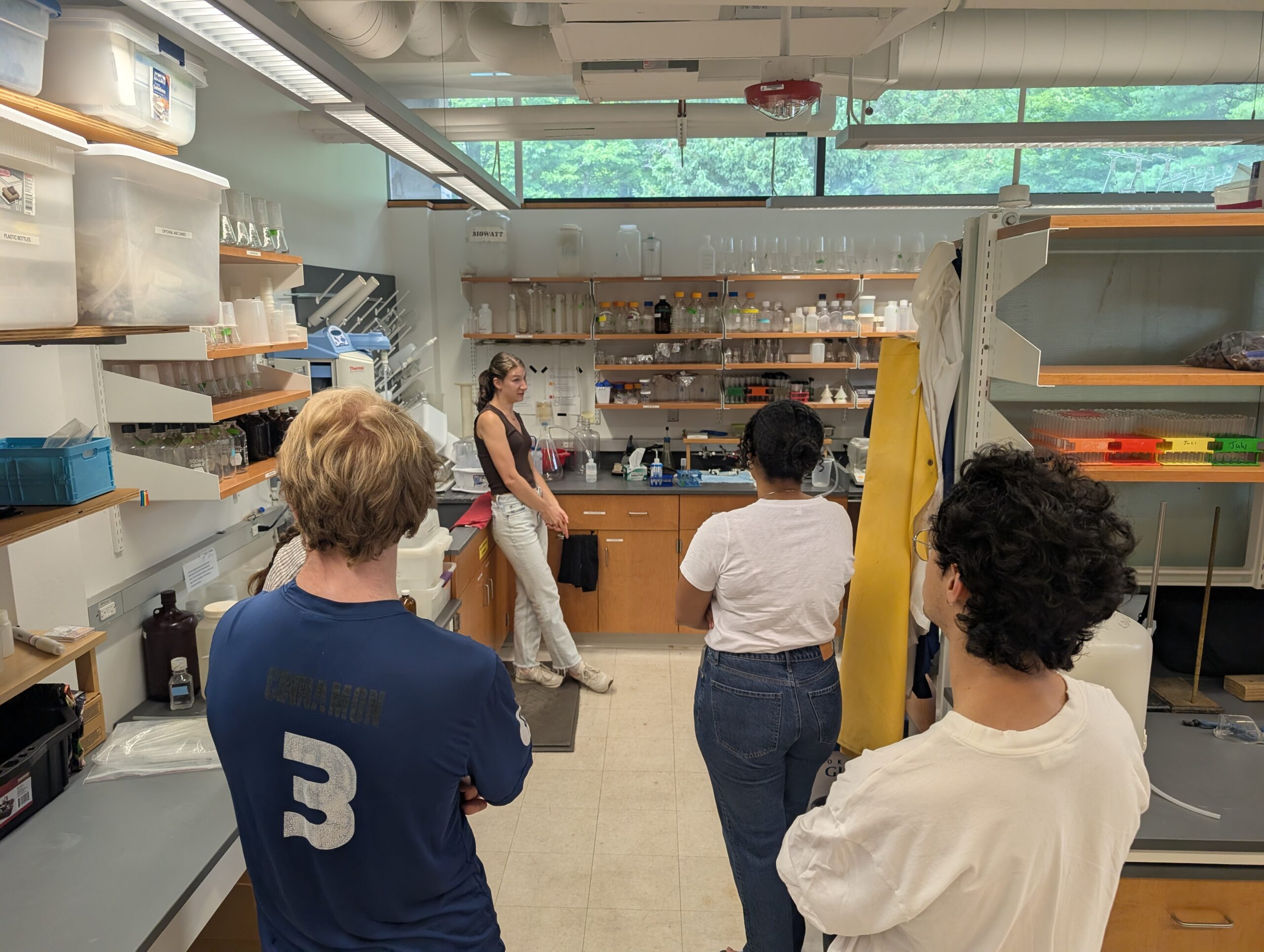
Meredith explains how she analyzes water samples for toxic cyanobacteria.
Next, Trinish showed us his building—the one that’s painted green—and gave our interns a primer on climate change science. He explained how current climate change is driven by greenhouse gas emissions from human activity. We discussed how modern-day climate change is different from the Milankovitch cycles, which are natural climate fluctuations that occur over the course of tens of thousands of years. These Milankovitch cycles are caused by changes in the Earth’s orbit around the sun, the tilt of the planet’s axis, and the direction the tilt is pointed in. We also talked about how historical mini-ice ages may have been caused by sun spots.
After a short break for lunch, we visited the Polar Geophysics Group’s laboratory, where PhD candidate Caitlin Locke showed us models of airplanes that fly over Antarctica and Greenland to measure the surface elevation, ice thickness, and internal structure of the ice sheets, in addition to changes in the Earth’s gravitational and magnetic fields. Caitlin uses the gravity data to model the seafloor under ice shelves (the floating extensions of ice sheets) to understand how warm ocean waters are flowing beneath them, and to predict where ice sheets might be vulnerable to melting from below. We saw the IcePod, a specially made imaging system for LC-130 Hercules aircraft, that contains the instruments that take these measurements.
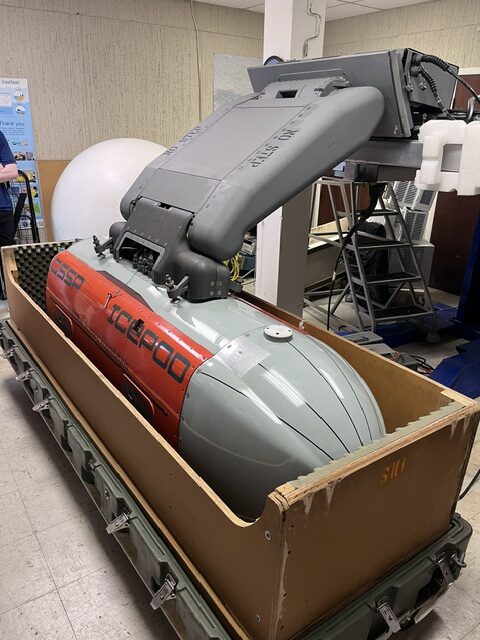
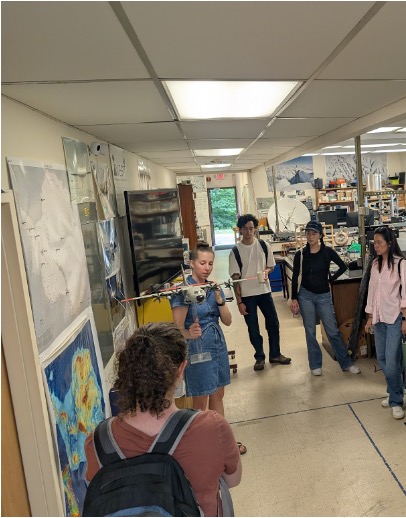
Left: The IcePod imaging system for LC-130 Hercules aircraft.
Right: Caitlin shows the Sabin staff and interns a model of the LC-130 aircraft she flies in.
Alan Garcia, another PhD candidate, spoke to our interns about his work on climate forecasting and weather patterns, specifically regarding how climate and weather predictions of rainfall patterns can help Guatemalan farmers adjust to a changing climate and maintain their livelihoods. He explained how changes in the El Niño–Southern Oscillation (ENSO) climate pattern could cause major droughts or flooding that would harm farmers, that climate change is making these patterns more unpredictable, and that calibrating these forecasts can help divert famine and other negative consequences.
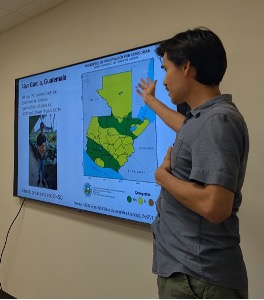
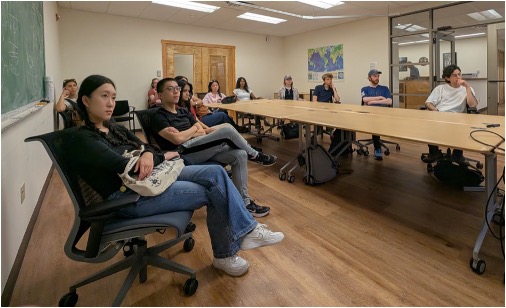
Alan explains his research to our students on weather forecasting and applications for Guatemalan farmers.
Finally, we visited the Rock and Ice Mechanics Lab with PhD candidate Charlotte Bate. Her research involves understanding how solid earth materials such as rock and ice deform under large amounts of stress, for example, at the bottom of a glacier. Climate change is causing glaciers to melt and retreat at faster rates, which can alter these deformation patterns and cause landslides. Indeed, one recent international lawsuit addressed the risk of flooding from glacial melt and changing landscapes in Peru. Charlotte showed us equipment that is used to run experiments deforming large blocks of ice and rock, including hydraulic presses and imaging equipment. Some of these machines are in a dedicated cold room, whose temperature is sometimes set to well-below freezing for certain experiments. Besides her own work, she also gave us a preview of the extensive LDEO machine shop inventory.
What an incredible day seeing how scientists are investigating the effects of climate change on earth processes and society. Armed with this education, our interns and staff are better prepared to tackle legal and policy issues in the climate space. Many thanks to all the researchers at LDEO who spent time with us, and a special thank you to Trinish Chatterjee in particular for the tour and arranging our meetings with everyone. We look forward to more partnerships between the Sabin Center for Climate Change Law and LDEO.
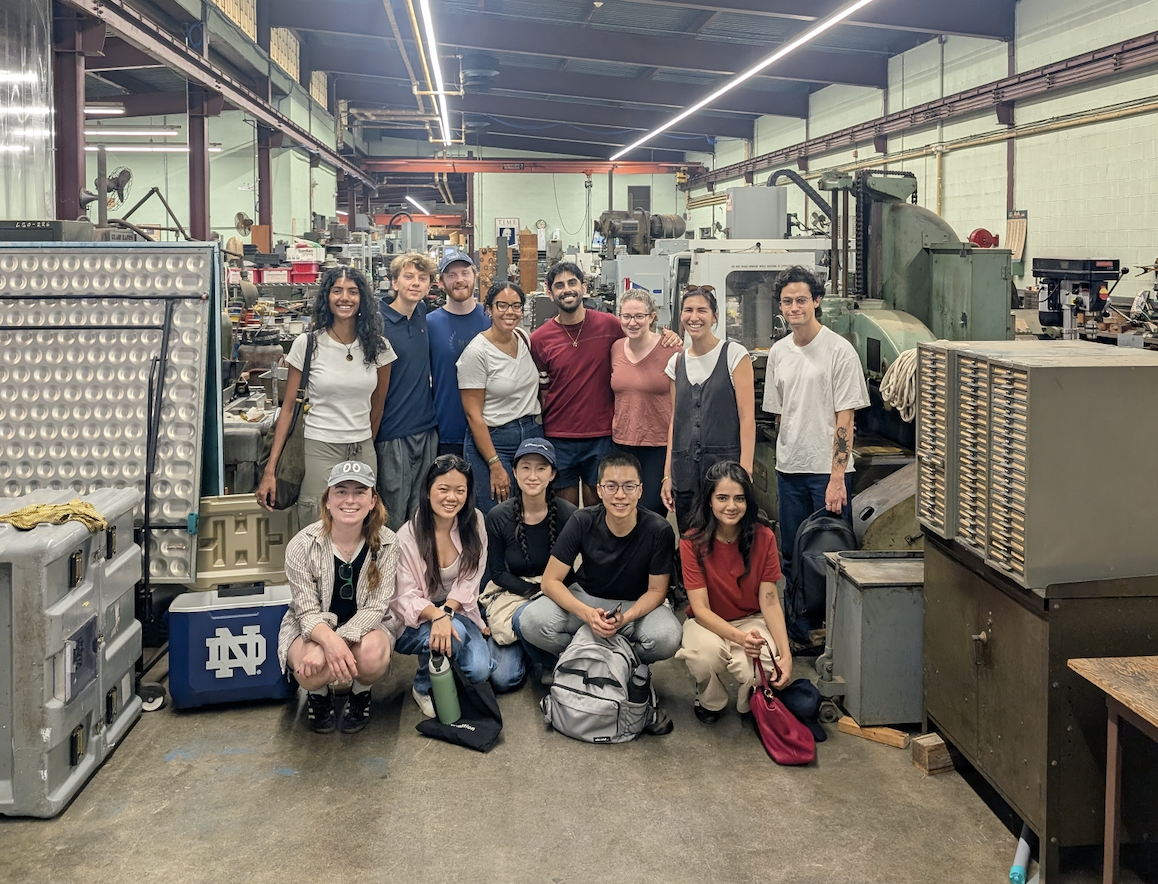
Sabin Center staff, interns, and Trinish in the LDEO Machine Shop.

Rebecca Lowy is the Climate Fellow at the Sabin Center for Climate Change Law at Columbia Law School.