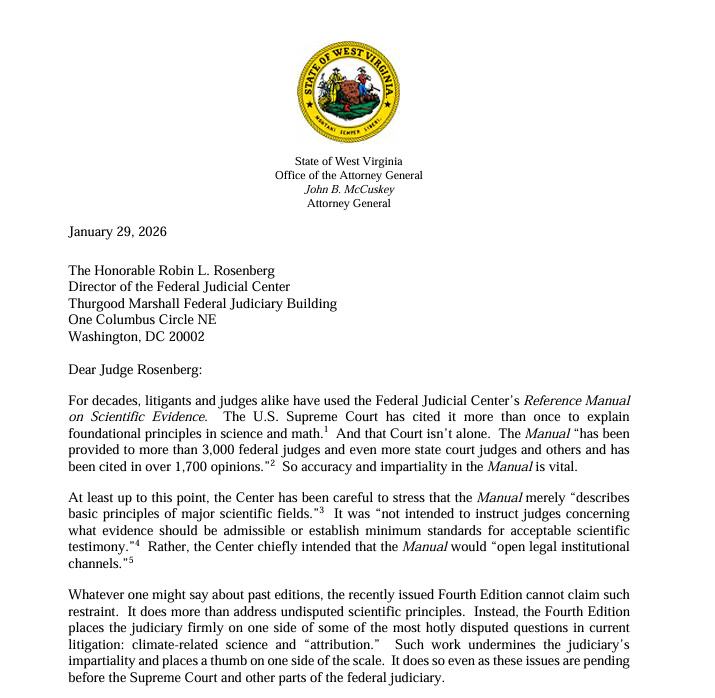
On January 29, 2026, a coalition of 27 state attorneys general, led by West Virginia Attorney General John B. McCuskey, sent a letter to the Federal Judicial Center (FJC) demanding immediate withdrawal of the “Reference Guide on Climate Science” from the Fourth Edition of the Reference Manual on Scientific Evidence (“Reference Manual”). Twenty-two of the state attorneys general also sent a letter to the House and Senate Judiciary Committees urging them to investigate and potentially defund the FJC based on their objections to the climate science chapter. Facing significant pressure, the FJC informed Attorney General McCuskey stating that it had “omitted the climate science chapter” from the Reference Manual on February 6, 2026. No further explanation was provided for the omission.
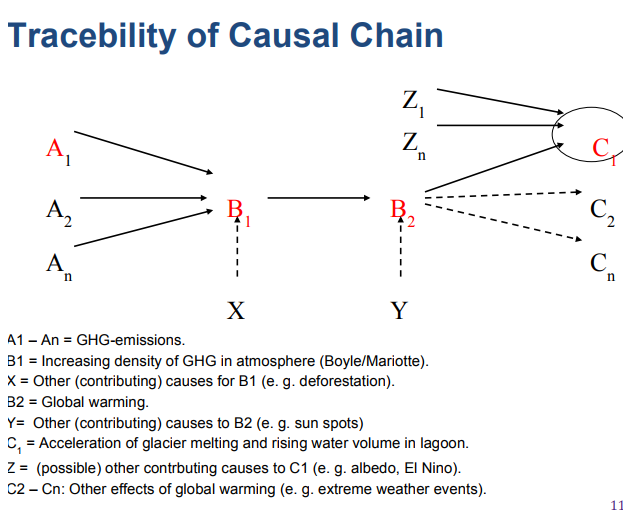
We wrote the climate science chapter. It provided foundational information about climate science to help judges evaluate the reliability and credibility of expert testimony. It described the core concepts and methodologies that underpin climate science – including physical understanding of processes such as the greenhouse gas effect and radiative forcing – and described how these tools have been used to assess observed changes in the climate system. The chapter acknowledged the scientific consensus on human-induced climate change while also recognizing areas of uncertainty in the research. In particular, it contained a detailed discussion of the varying levels of scientific confidence and uncertainty across different areas of climate change detection, attribution, and projection. The chapter underwent extensive peer review from external reviewers, including both scientists and judges, as well as staff from the National Academies and the FJC. It was held to the same rigorous standards as every other chapter in the manual.
In their letter to the FJC, the state attorneys general claimed that the chapter would bias the judiciary because it contained “conclusive opinions on matters of serious dispute” – specifically, that human activities have “unequivocally warmed the climate,” that it is “extremely likely” human influence drives ocean warming, and that researchers are “virtually certain” about ocean acidification. They also criticized other aspects of the chapter, such as the reliance on scientific authorities like the Intergovernmental Panel on Climate Change, and the discussion of climate change impact attribution.
We prepared a detailed response to each of the substantive criticisms raised in that letter. As explained therein, there is overwhelming scientific support for the conclusion that humans have warmed the climate, resulting in widespread changes to the atmosphere, ocean, biosphere, and cryosphere. The response also deals with other critiques and explains why it would be unethical to suppress scientific information simply because it is inconvenient to some litigants.
Although the FJC has removed the chapter from its version of the Reference Manual, it is still available through the National Academies website, and has received support from climate scientists who are also concerned about the suppression of information about climate change. The state attorneys general are now pressuring the National Academies remove the chapter from their version of the Manual as well.

Jessica Wentz
Jessica is now a non-resident senior fellow at the Sabin Center.

Radley Horton
Radley Horton is a Professor at Columbia University’s Climate School. His research focuses on climate extremes, tail risks, climate impacts, and adaptation.