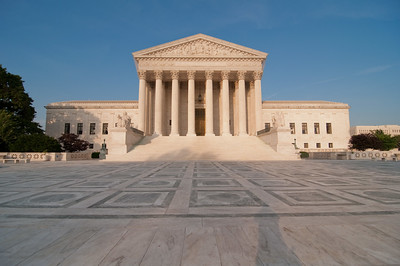
On Monday, October 5, the Supreme Court will open its 2026–2027 term by hearing a climate change case, Suncor Energy (U.S.A.) Inc. v. County Commissioners of Boulder County (Suncor). The defendant fossil fuel companies are asking the Court to hold that the Constitution and the Clean Air Act preempt state-law claims seeking to hold the companies liable for their contributions to climate change injuries to Boulder. The case has potentially significant ramifications for other cases filed against fossil fuel industry defendants over the past 10 years and also could impact the permissible scope of state and local climate change policies. Eight justices will hear the case; the Court informed the parties earlier this week that Justice Alito will not participate.
This post provides background on Suncor and an overview of the preemption issues raised by the fossil fuel companies. It also discusses potential outcomes of the Suncor hearing and implications for other climate cases as well as possible implications for state and local climate policymaking.
Background on Boulder’s Case
The County Commissioners of Boulder County and the City of Boulder (together, Boulder) filed their suit in 2018 in Colorado state court seeking damages and other relief for climate change-related injuries suffered as a result of the defendant fossil fuel companies’ actions, including wildfires and extreme weather. Boulder asserts causes of action for public nuisance, private nuisance, trespass, and unjust enrichment.
The case, like other cases brought by state and local governments against fossil fuel defendants, was tied up for many years by the defendants’ unsuccessful efforts to move the case to federal court. In June 2024, the Colorado trial court denied a motion to dismiss Boulder’s common law claims. (The trial court did, though, dismiss a claim under the Colorado Consumer Protection Act.) The defendants filed a petition for order to show cause in the Colorado Supreme Court, and the court agreed to consider whether the district court had erred in concluding Boulder’s claims could proceed under state law. In May 2025, the Colorado Supreme Court ruled that federal law did not preempt Boulder’s claims. The companies filed a petition for writ of certiorari in August 2025, and on February 23, 2026, the Supreme Court granted the petition.
Boulder’s case against the companies presents two primary theories of liability: (1) a “deception” theory based on the companies’ allegedly misleading marketing of their products and (2) a “sales and production” theory based on allegations that the companies “knowingly caused and contributed to the alteration of the climate by producing, promoting, refining, marketing and selling fossil fuels at levels that have caused and continue to cause climate change.”
The Fossil Fuel Companies’ Theories of Preemption
The fossil fuel companies argue that regardless of how Boulder characterizes its theory of liability, the claims seek relief for “injuries allegedly caused by the effects of interstate and international greenhouse-gas emissions on the global climate” and are preempted by the Constitution and the Clean Air Act.
Very briefly, the companies’ theories of preemption and Boulder’s arguments in response include:
– Constitutional structure. The fossil fuel companies argue that two principles that make up the Constitution’s “fundamental structure”—equal sovereignty and extraterritoriality—limit states’ ability to regulate interstate air and water pollution. The companies contend that because Boulder seeks relief for the local impacts of climate change, its claims “necessarily seek to regulate activities outside Colorado that are contributing to global climate change” and “inherently” involve interstate emissions. According to the companies, the claims are therefore preempted. In response, Boulder argues that the principle of equal sovereignty has not foreclosed application of state law to remedy in-state harms from out-of-state torts. Boulder also argues that the fossil fuel companies are advocating for an expansive and “standardless” conception of “extraterritoriality” that extends far beyond the Court’s precedents.
– Foreign affairs doctrine. The fossil fuel companies argue that allowing plaintiffs such as Boulder to hold companies liable for international greenhouse gas emissions would interfere with U.S. foreign policy on climate and energy matters. The companies argue that the Constitution vests exclusive authority over foreign affairs in the federal government and therefore precludes Boulder’s state-law claims to the extent they seek relief for injuries caused by international emissions. In response, Boulder argues that the companies must—and fail to—show a clear conflict between their claims and an express federal foreign policy in order for the foreign affairs doctrine to apply.
– Clean Air Act. The companies contend that the Clean Air Act’s “pervasive statutory scheme” occupies the field of air quality regulation and that Boulder’s state-law claims would “conflict with” and “undermine” that scheme, including the U.S. Environmental Protection Agency’s determinations pursuant to that scheme about whether and how to regulate emissions. Boulder argues that the Clean Air Act’s savings clause forecloses implied field preemption and that nothing in either Boulder’s deception-based claims or its sales and production-based claims conflict with the Clean Air Act’s scheme, which does not regulate marketing, upstream production, or sales of fossil fuel products.
Potential Outcomes
It will likely be several months before the Court issues a decision, but on Monday, the eight participating justices’ questions may suggest which of these theories of preemption they do or do not find potentially relevant and which arguments they do or do not find persuasive.
In addition, there is a chance that the Court could show interest in the question of whether it has statutory and Article III jurisdiction over the case. Boulder’s opposition to the petition for writ of certiorari addressed these jurisdictional issues at some length, and the Court’s order granting certiorari requested that the parties brief them. (An earlier Climate Law Blog post provided a brief overview of the statutory and Article III jurisdictional questions.)
It is therefore possible that Suncor could result in a decision that returns the case to the Colorado courts for more proceedings without addressing the substantive preemption questions.
If the Court does reach the merits of the preemption issues, the Court could, as my colleague Michael Burger discussed here, choose to address separately the preemption doctrines’ application to Boulder’s deception-based and sales and production-based theories of liability, or the Court could address the claims together or decline to distinguish the theories. In his view, the most appropriate approach would be to address the deception and sales-and-production theories separately so that the focus of the preemption analysis is on the specific “tortious activity at the start of the causal chain” and key questions regarding duty and remedy are transparently assessed.
Impacts on Other Climate Cases and Climate Laws
As discussed in an earlier Climate Law Blog post, other pending cases brought by states, local governments, Tribes, and (in a couple of more recently filed cases) individuals against fossil fuel companies do not present a monolith of claims. There are approximately 35 such cases in the Sabin Center’s Climate Litigation Database. Some of these cases, like Boulder’s, assert both sales and production-based claims and deception-based claims (see, e.g., Multnomah County). Most of the cases, however, focus on deception-based theories of liability (see, e.g., Bucks County (Pa.), the State of California and California local governments, Chicago, Connecticut, Delaware, District of Columbia, Hoboken (N.J.), Honolulu, Kennedy, Leon, Maine, Makah Indian Tribe, Massachusetts, Minnesota, New Jersey, New York City, Shoalwater Bay Indian Tribe, Vermont). Even among the deception-focused cases, however, the causes of action, the harms allegedly suffered as a result of climate change, and the requested remedies differ.
The Supreme Court’s approach to the preemption analysis of Boulder’s claims could determine whether its ultimate decision has a sweeping impact on the viability of the claims in these cases or an impact that must be determined on a case-by-case basis. If the latter, the Supreme Court’s analytical approach could also affect how much guidance the Court’s decision provides to litigants in evaluating their options for claims and defenses.
A Supreme Court decision on preemption could also affect ongoing litigation challenging New York’s (United States v. New York and West Virginia v. James) and Vermont’s (Chamber of Commerce v. Moore) climate change superfund laws, which would require certain major greenhouse gas emitters to contribute to funds to finance climate adaptation projects. Two New York U.S. District Courts (the Northern District and the Southern District) recently held that the Clean Air Act and foreign affairs doctrine preempt New York’s law. New York has not yet appealed these rulings. How Suncor applies the preemption doctrines to Boulder’s claims is likely to shape the Second Circuit’s approach to evaluating their application to the New York law in any appeal.
In addition, at least 12 other states also have considered or are considering whether to enact similar climate superfund laws. Suncor will likely inform policymakers’ decisions on such laws. Depending on its outcome, Suncor also could have an impact on other state and local climate-related laws and policies. For example, in their reply brief in Suncor, the fossil fuel companies acknowledged that “[t]o be sure, not all state regulations of conduct affecting the level of nationwide greenhouse-gas emissions conflict with the Clean Air Act.” They cited gasoline taxes and energy-efficiency standards as valid regulations of in-state conduct.
What the Supreme Court determines in Suncor about Boulder’s deception and sales-and-production claims could have ramifications for the extent to which states and localities can exercise their police powers to address the challenges of climate change.