On August 20, 2026, the U.S. Forest Service (USFS) published a proposal to repeal the 2001 Roadless Area Conservation Rule (“Roadless Rule”), which prohibits new road construction, commercial timber harvests and other activities on 58.5 million acres of undeveloped public lands. As detailed in the draft environmental impact statement (DEIS) accompanying the proposed repeal, USFS is proposing to remove protections on 44.7 million acres of land (encompassing all roadless areas outside of Colorado and Idaho, which regulate the remaining areas under state programs – the Idaho Roadless Rule and Colorado Roadless Rule). (The proposal also includes an alternative action, which would remove protections on 31.7 million acres.) Though the proposal does not discuss the issue in depth, both options would remove protections from 9.3 million acres in the highly sensitive Tongass National Forest in Southeast Alaska. The repeal would open all of these presently protected areas to road construction, commercial timber harvest, and other development activities, including oil and gas extraction.
One of the purported rationales for this action is to provide greater flexibility and enhanced local control for “active forest management” projects to address wildfire risk, forest health, and other resource management objectives. This is a laudable goal – research suggests that fuel treatments, habitat restoration, and other management projects can significantly improve forest health, reduce wildfire severity, and help with post-fire recovery (see here, here and here.) But the DEIS does not provide any evidence that repeal of the Roadless Rule will deliver any tangible benefits related to forest health or wildfire risk. And, in fact, the available evidence suggests that it will have the exact opposite effect, increasing wildfire risk and ecological harm by opening protected areas to human development and extractive uses. The DEIS also fails to adequately consider how the repeal of these protections may affect other resources, including drinking water and biodiversity, and how climate change may interact with and exacerbate the environmental impacts of the proposal. For the most part, it ignores these issues altogether.
These analytic flaws and gaps are significant, and could, if carried through into the final EIS, result in clear violations of the National Environmental Policy Act (NEPA). This blog provides further details.
Context for the Roadless Rule Repeal
The 2001 Roadless Rule was adopted to provide lasting protections for undeveloped lands within the National Forest System (NFS), thereby preserving the social and ecological values of roadless areas, including benefits related to watershed protection, ecosystem health, and habitat conservation (36 CFR Part 294), and conserving these areas for the long-term benefit of present and future generations (16 U.S.C. §1609). Research suggests that the rule has been highly effective at achieving these goals: inventoried roadless areas are among the highest integrity forest ecosystems in the U.S. The absence of roads and other human developments in these areas significantly reduces the spread of invasive species as well as human caused wildfire ignitions, as compared with other NFS lands. These conclusions are supported by USFS’ monitoring data and research.
Regardless, USFS claims that repeal of the Roadless Rule is warranted because (a) conditions have changed substantially since 2001 – with “increasing drought, extreme temperatures, wildfire frequency and severity, and insect and disease outbreaks” – and (b) the Roadless Rule supposedly limits USFS’s ability to conduct vegetation management in roadless areas. USFS reasons that “there is a need to increase local management flexibility and, where necessary, allow for active management to respond to changing and localized conditions, such as increasing wildfire risk, the spread of insect and disease infestations, and the need for community protection in the wildland-urban interface.” USFS does not discuss climate change, despite the obvious focus on climate-related impacts.
USFS alludes to extractive uses in its discussion of the “Purpose and Need” for the repeal, but does not specifically cite timber harvests or other extractive uses as justifications for it. An increase in timber harvests and extractive uses are treated as outcomes of the action, but not the motivating rationale. Which is interesting, because…
… Repealing the Roadless Rule will not achieve the goals set out by USFS
There is a fundamental mismatch between the DEIS’s characterization of the purpose and need for the action and what is actually being proposed. First, the DEIS does not demonstrate that the Roadless Rule is currently preventing needed vegetation management projects. Instead, the DEIS recognizes that budget and funding constraints – which have been exacerbated by recent budget cuts and staff layoffs at USFS – are the primary barrier to active forest management. The repeal of the Roadless Rule will not generate funds for vegetation management projects; anticipated revenue from timber sales and other resource extraction will be used to partially offset road construction and maintenance costs. According to the DEIS, USFS is already facing $6.9 billion in deferred maintenance costs for roads and bridges, and repealing the Roadless Rule will ultimately exacerbate this problem because the anticipated revenue from extractive activities “would not be sufficient to cover the costs of constructing and maintaining all new roads related to a project.”
Second, there is no commitment to conduct vegetation management or fuel treatment projects, and the DEIS does not find that such projects are even likely. Rather, the DEIS treats these projects as a hypothetical possibility. In contrast, the DEIS states that a primary outcome of this action will be to increase the national timber harvest by an estimated 5-10%, with nearly 5 million acres that will likely be made available for commercial logging.
Third, the DEIS does not establish that existing exceptions under the Roadless Rule – which allow tree cutting for forest health project and wildfire risk reduction, as well as road building to address imminent and catastrophic safety risks – are insufficient to support needed vegetation management actions. If these exceptions are too restrictive, this could be addressed through a much narrower rule amendment that does not open currently protected lands to commercial logging and oil and gas extraction. For example, the Idaho Roadless Rule authorizes temporary road construction to reduce hazardous fuel conditions when specific conditions are met (36 C.F.R. § 294.23(b)(3)). The Colorado Roadless Rule also authorizes temporary road construction to address wildfire hazards to at-risk communities and municipal water supply systems, and where needed to “maintain or restore ecosystem composition, structure, and processes” within designated Community Protection Zones. (36 C.F.R. § 294.43(c)(1)(vi)-(vii)).
And fourth, the repeal is more likely to make the problem worse, not better. As described further below, the opening of currently protected lands to road construction, logging, and other activities will, among other things, almost certainly increase wildfire ignitions.
Wildfire Risk and Fuel Treatments
In the discussion of wildfire impacts, the DEIS says that there will be both beneficial and adverse impacts, specifically: (i) roads could provide access for fuels treatment and firefighting, and (ii) more roads and human development could increase human-caused ignitions.
The second point is important, here, as it is so dramatically under-considered. The DEIS shows that the repeal will significantly increase in fire risk. As illustrated in Table 18. ignition density is nearly four times higher in NFS lands that are not subject to Roadless Rule protections, and the area burned (as a percent of total land area) is also substantially higher on unprotected NFS lands.
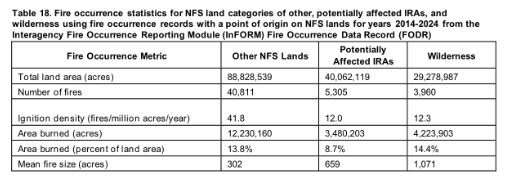
Nonetheless, the DEIS concludes that the net impact of the action on wildfire risk is likely small due to the potential for improved firefighting response times and “initial attack success,” resulting in shorter fire duration. But the agency offers no evidence to support the conclusion. The DEIS notes that while wildfire ignitions and burned acres are substantially lower in roadless areas, but finds that fire containment times are substantially longer, and, based solely on this, assumes that new road construction will result in more rapid and effective fire suppression in those areas. That counter-intuitive assumption is insufficient to justify opening tens of millions of acres of public lands to new roads and extractive industry.
There are several other major errors and omissions in the wildfire analysis:
- As noted above, the DEIS provides no evidence of a “treatment deficit”—a lack of fuel management activities—on IRAs as compared with other NFS lands.
- The DEIS fails to account for the fact that the proposed action does not include any binding commitments to implement fuel treatment programs, nor does it propose any specific mitigation or monitoring measures to address the increased fire ignition risk associated with opening currently protected areas to roads and other development.
- The DEIS essentially ignores USFS’s own data and dismisses the three decades of data showing increased density of ignitions near roads.
- The longer containment times in roadless areas could be explained by the fact that USFS allows some naturally ignited fires to burn in natural areas. So the longer containment times that underly the DEIS’s justification are not necessarily indicative of worse wildfire outcomes, and may be indicative of healthy forest management practices.
- Relatedly, opening up natural lands to human development could interfere with USFS’s use of naturally ignited fires for forest management because USFS may need to increase suppression efforts in order to protect timber resources and built infrastructure.
- Commercial logging can also significantly increase wildfire risk and severity,. There is essentially no discussion of this issue in the DEIS.
- Climate change can significantly increase wildfire risk and severity, and alter wildfire dynamics in ways that have important implications for this analysis. But the DEIS does not talk about that, at all.
Other Impacts of Repealing the Roadless Rule: Forest Health, Invasive Species and Pest Outbreaks, Watershed Protection, and Biodiversity
The DEIS follows a similar pattern in its assessment of other environmental impacts and management considerations, including: invasive species and pest outbreaks, watershed health and drinking water quality, and biodiversity protection. Specifically, the DEIS: (a) presents data showing that roadless areas outperform other NFS lands across all of these impact categories; and (b) acknowledges that the repeal of the Roadless Rule will result in degradation of resource values and exacerbation of environmental harms; but then (c) downplays the severity of these impacts, often concluding – without substantiation – that the construction of roads will partially mitigate the adverse impacts caused by the construction of roads. As discussed above, this conclusion is based on assumptions about hypothetical management projects for which there are no firm commitments or funding.
Ultimately, the DEIS’s conclusions about the (non)severity of environmental impacts are impossible to reconcile with the evidentiary record. According to the DEIS, the repeal is “likely to adversely affect” 327 species and 71 critical habitats that are protected under the Endangered Species Act (ESA). This appears to be one of the largest ESA adverse effect determinations in the history of NFS management. But the DEIS defers any meaningful analysis of the effects to another day, claiming it is not possible because it “does not have a reliable method to identify, describe, or analyze the likelihood and location of any future projects that may be proposed for currently inventoried roadless areas.”
Which, again, is interesting, because…
… The DEIS does analyze future projects to project economic benefits, even as it denies it can do so for environmental harms
There is a striking difference between the DEIS’s treatment of uncertainty with regards to potential adverse environmental impacts and with regards to the potential benefits of timber harvest. The DEIS declines to quantify many adverse effects because the location and extent of future projects are uncertain, yet it does quantify the potential economic benefits of repealing the Roadless Rule (e.g., 4.8 million potentially operable acres and 253,000–557,000 ccf/year of additional potential harvest). The result is an analysis that is heavily skewed towards economic benefits and which largely overlooks or minimizes the adverse environmental consequences.
Of course, USFS’s claim that it cannot identify the likelihood and location of future projects is directly contradicted by the fact that it used detailed geographic data to identify potential logging areas and yields. The agency mapped where commercially valuable timber is located and considered factors such as slope topography, distance from roads, site productivity, statutory restrictions, and the feasibility of different logging systems to develop an overall estimate of the potential increase in timber harvests. USFS did use some geographic data in its assessment of adverse effects (e.g., the water quality analysis included some consideration of slope topography), but it largely deferred meaningful analysis to subsequent stages, and avoided reaching meaningful conclusions about the magnitude or significance of adverse impacts.
In the context of environmental review, this is a difference that matters. That kind of unexplained, differential treatment has sunk EISs in other contexts in the past.
No consideration of climate change effects
The DEIS cites changed conditions including increases in extreme temperature, wildfire risk, drought, and insect and disease outbreaks as a key rationale for the proposed repeal. However, the DEIS completely ignores the fact that these trends are attributable to anthropogenic climate change, and it does not account for future change in its effects analysis. Instead, it relies on historical data to establish the environmental baseline for its assessment.
The DEIS also glosses over the effect of the proposal repeal on carbon sequestration. Despite identifying approximately 0.9 billion metric tons of stored carbon in affected roadless areas, the DEIS does not quantify or asses the significance of potential effects on forest, soil, dead-wood, or product carbon or future sequestration. It simply concludes that “some areas would lose capacity for carbon sequestration” but this would be partially offset by the storage of carbon in harvested timber products.
Although agencies have discretion regarding how to analyze climate impacts in environmental reviews and regulatory actions, the complete omission of climate change data – and the cursory analysis of carbons sequestration impacts – is likely a violation of NEPA as well as Administrative Procedure Act (APA) rulemaking requirements.
Conclusion
USFS says that this dramatic reversal of the preservation of large roadless areas in America’s public lands is necessary to improve vegetation management, forest health, and wildfire resilience. The record to date does not establish that the repeal will actually produce those benefits. And the science suggests that just the opposite is likely: less healthy forests, less resilient forests, and more fire, along with adverse impacts on biodiversity and water resources. In other words, USFS has offered an explanation that “runs counter to the evidence before the agency.” See Motor Vehicle Manufactures Ass’n v. State Farm, 463 U.S. 29 (1983). It has also nearly completely ignored climate change, a major factor in properly assessing the proposed repeal and its impacts. Even under the deferential standards of judicial review afforded in NEPA cases, this DEIS has a ways to go before it should be able to withstand legal scrutiny.

Jessica Wentz
Jessica is now a non-resident senior fellow at the Sabin Center.

Michael Burger
Michael Burger is the Executive Director of the Sabin Center for Climate Change Law and Senior Research Scholar at Columbia Law School.