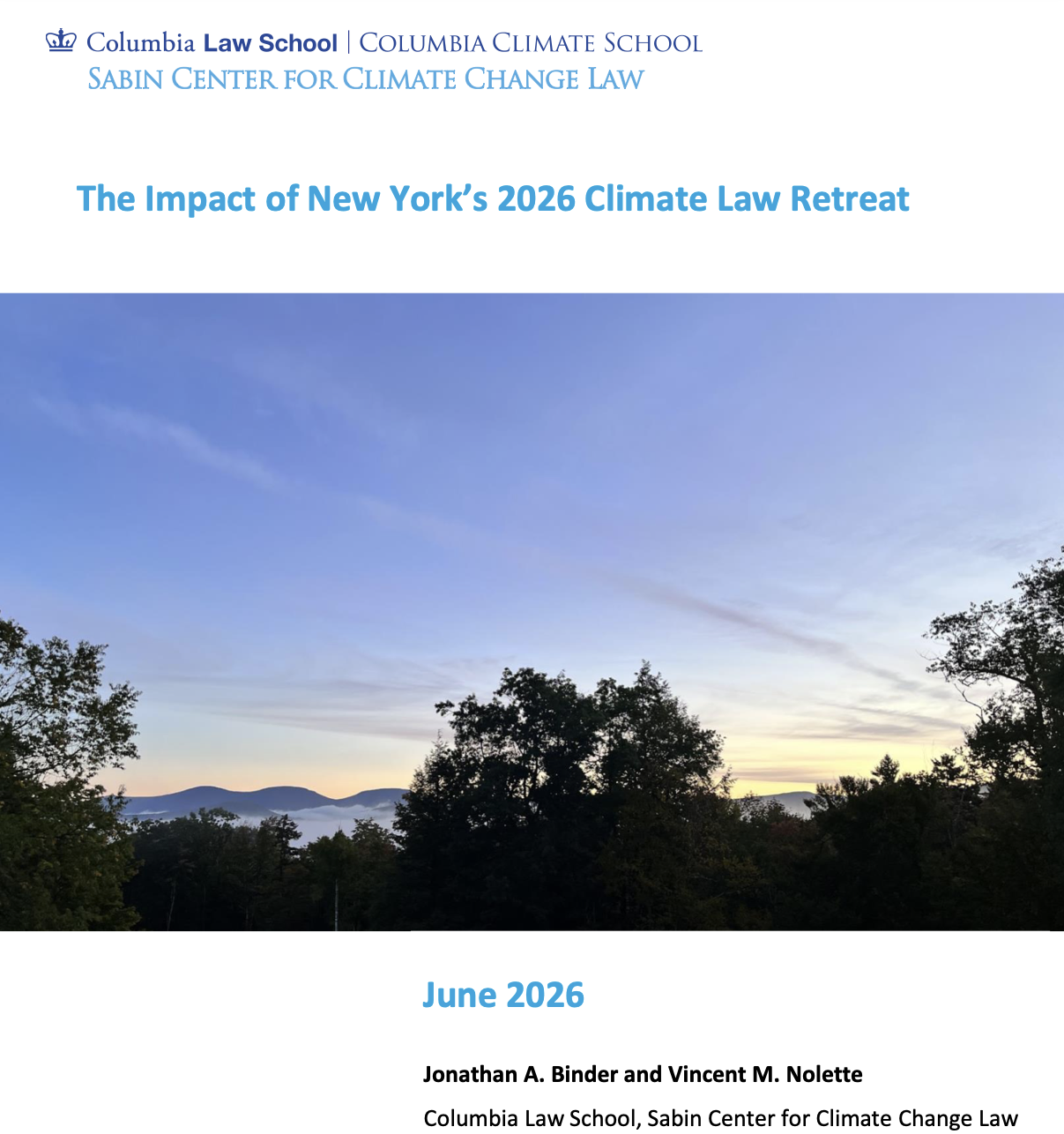
 Today, the Sabin Center published a new white paper, The Impact of New York’s 2026 Climate Law Retreat. The paper examines the implications of the State’s 2026 Amendments to the Climate Leadership and Community Protection Act (CLCPA), including how the changes will affect planning, permitting, implementation, and litigation.
Over the last two decades, as the risks and impacts of climate change have progressively worsened, various states have enacted sweeping climate laws aimed at mitigating greenhouse gas (GHG) emissions and transitioning fossil-fuel dependent energy systems to clean energy grids. Perhaps none was as ambitious as New York’s CLCPA. Under the CLCPA, the State committed to reducing emissions statewide by 85% from 1990 levels by 2050, as well as various interim emissions reduction and energy generation targets. To actually implement these requirements, the details were left in large part to recommendations by the Climate Action Council’s Scoping Plan and to regulatory action by administrative agencies.
Since 2019, New York has made substantial progress toward these targets. However, it has been less than hoped for and needed under the Act. The State did not meet its deadline to promulgate implementing regulations and Governor Kathy Hochul chose to delay a cap-and-invest program that would have made further progress. To wit, it did not appear that, under its current trajectory, the State would have achieved its (now amended) interim emissions reduction target of 40% reduction in GHG emissions from 1990 levels by 2030. In addition to the Governor’s own decisions, myriad factors have contributed to the State’s climate shortcomings, including the dismantlement of federal legislation like the Inflation Reduction Act, the advent of the second Trump administration and its antipathy toward renewable energy in general and offshore wind in particular, and supply chain costs triggered by rising inflation. Governor Hochul relied upon these economic and political challenges to urge the State legislature to enact amendments to the CLCPA that would significantly weaken the law. On May 26, 2026, the State Legislature did so, changing inter alia the Act’s GHG emission accounting methodology, the statewide GHG emission limits, and the requirement to adopt implementing regulations.
In our first blog, we unpacked the rollbacks to the CLCPA. Our white paper expands on our earlier summary of the 2026 Amendments by examining how they will affect CLCPA implementation going forward. Though many impacts are uncertain, the paper explains what has been lost, and where possible, what the amendments mean in practice. Though the 2026 Amendments materially weaken the legal mechanism that previously required the State to engage in comprehensive climate action, they nevertheless leave open the possibility for the State to pursue meaningful climate policies. In the coming months and years, public-facing regulatory actions and litigation – in sharp contrast to the closed-door budget process that led to the amendments – will determine the precise impacts of the 2026 Amendments. To effectuate the 2026 Amendments, regulatory agencies will need to, once again, devote considerable time and resources towards multiple administrative steps. As we note in the paper, state agencies charged with implementing the CLCPA, like the New York State Department of Environmental Conservation, along with the support of various stakeholders, still have the opportunity “to maximize the Act’s benefits through strong implementation.”
Read the full white paper here.

Jon Binder

Vincent M. Nolette is the Sabin Center's Equitable Cities Climate Law Fellow.