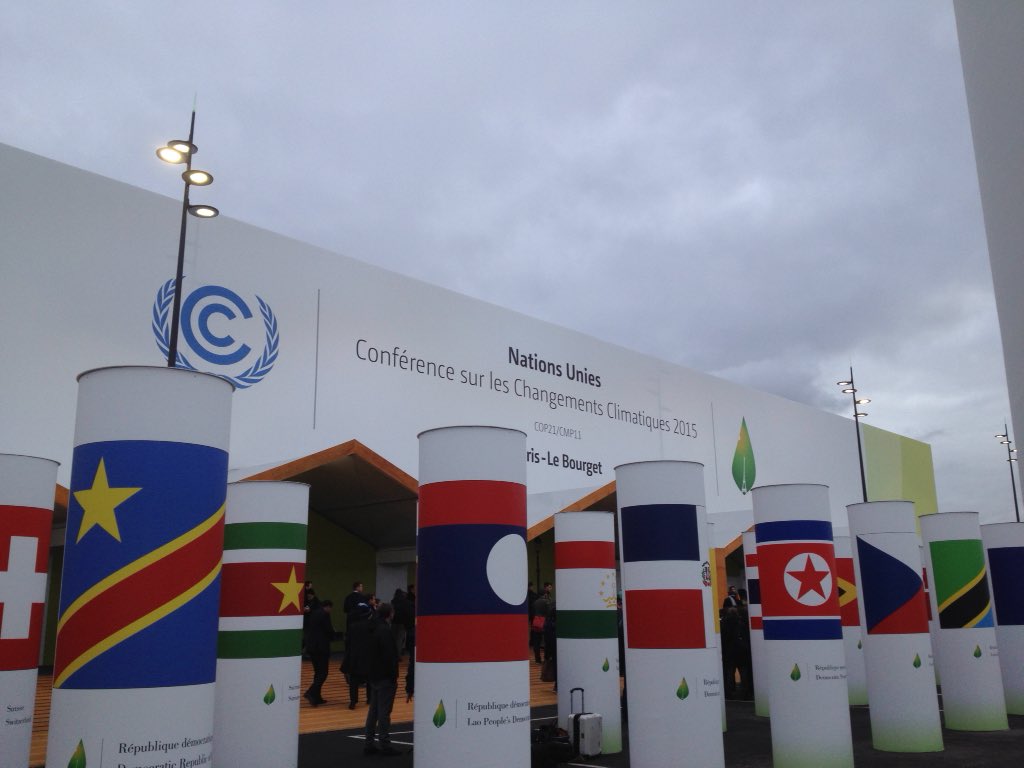
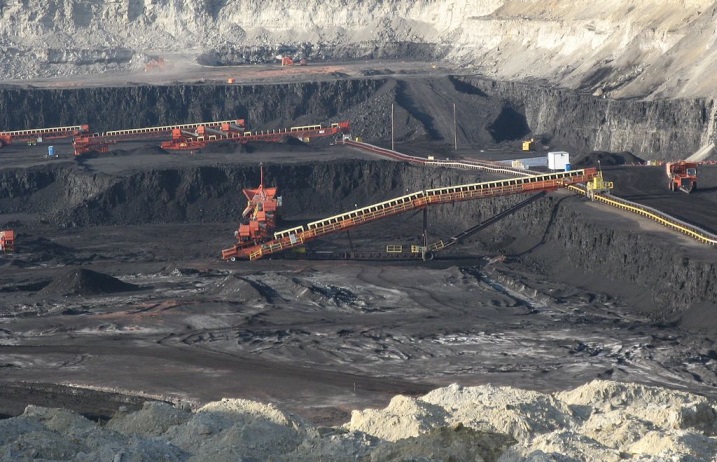
The number of climate change lawsuits brought before domestic, regional, and international courts is growing at an unprecedented pace, with courts increasingly being asked to hold governments and corporations accountable for the harms associated with our warming planet. Most of the focus in the scholarship so far has been on whether such cases can be brought and how to navigate procedural hurdles like jurisdiction and causation. Far less discussed is a third critical element: how much should be paid for climate damage, i.e. the“quantum” of damages. This post explores the often overlooked issue of calculating damages in climate change lawsuits, drawing on insights from an award-winning research paper (2023 Galli Prize). By comparing approaches in the U.S. and abroad, it shows how economics can help align legal damages with the true costs of climate change and improve the deterrence effect of climate laws.
Damages and Deterrence: the Economic Perspective
Why does an award for climate damage matter beyond the order to reduce emissions? The economic theory of liability offers an eye-opening perspective on this question. The basic idea is that people respond to incentives, and the law plays a crucial role in shaping behavioral incentives. The amount of damages awarded by courts is specifically linked to the costs of precaution borne by polluters. It is well known that if a factory or an oil company knows that every tonne of carbon it emits will eventually incur liability costs, it will have a strong financial incentive to reduce emissions or invest in prevention. Furthermore, if the cost of liability includes all losses suffered by society, the polluting company will consider such figures when making decisions to minimize environmental risks. Conversely, if the expected amount of monetary compensation grossly underestimates the actual loss to society, polluters will not invest as much in prevention as they should; they will continue as before while society bears the costs.
It often happens that the amount of damages awarded differs from the actual loss suffered by society. The underlying reasons for such mismatch can be multifold. Scholars have identified the occurrence of asymmetries in the information available to the parties involved in litigation, as well as errors made by the courts, and the difficulty of estimating certain types of harm, such as non-pecuniary losses. Non-pecuniary losses specifically refer to goods that have no market price and therefore cannot be compensated for with money. They are peculiar to human and ecological damages, raising the fundamental question of whether they should be compensated at all.
Setting aside more complex scenarios, scholars of law and economics agree that, to encourage precautionary measures, those responsible for damage should be charged with all the costs it gives rise to, including the non-monetary ones that are more difficult to assess, to the extent that the assessment costs are not excessive. For this reason, also in the context of climate change, it is essential to address both liability and valuation.
From Natural Sciences to Economic Valuation
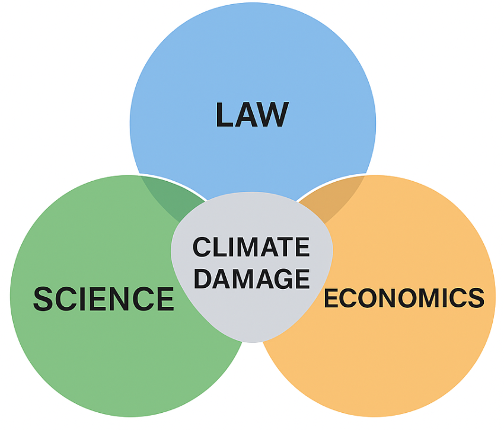 Quantifying climate damage is challenging because it requires expensive technical measurements, as well as the expertise and willingness of all parties involved, including the courts, to bear related assessment costs.. Against this backdrop of complexity, the judicial approach to quantifying climate damage does not always reflect the close link between three fields that should ideally work together: climate science, climate economics and climate (tort) law.
Climate scientists can now link greenhouse gas emissions with tangible physical impacts, such as rising sea levels, more intense storms, biodiversity loss and public health crises, with increasing confidence: they are focused on all kinds of material consequences from climate change. On the other hand, climate economists view climate change as a significant cost that impacts economic growth and welfare: they are primarily focused on those consequences that can be monetary quantified. Traditionally, economists have made a general distinction between economic and non-economic losses from climate change, i.e. monetary and non-monetary. This distinction is clearly evident in the Loss and Damage (L&D) debate, where ‘losses’ refer to monetary harm, such as that to buildings and private property, while ‘damages’ relate to non-monetary, irreversible effects such as health issues, loss of life, coastal erosion, and impacts on biodiversity. To quantify these losses, two approaches dominate in climate economics: (1) the total damage calculation and (2) the marginal damage calculation.
The total damage is calculated by adding together all the economic impacts of climate change on the gross domestic product. Although a number of methods have been developed (enumerative, statistical, and hybrid), models are mostly only able to capture certain effects (such as those on agriculture, forestry, water and air quality) with a high level of certainty, whereas the effects that are more uncertain are only partially included in current models. Tol defined three ‘big unknowns’: extreme climate scenarios, the effect of climate change in the very long term, and the impact of climate change on biodiversity. Due to the difficulty of factoring these unknowns in, they have largely been ignored and not accurately quantified.
Compared to studies on the total costs of climate change, the scholarship on marginal climate damage is much richer. Marginal climate damage differs from total damage in that it measures the marginal change in economic welfare resulting from the emission of an additional unit of carbon dioxide. This approach is also known as the Social Cost of Carbon (SCC) and is used by policymakers to set carbon taxes or evaluate regulations. The aim is to make polluters pay roughly the cost of the harm they inflict on society.
Despite decades of refinement, both the total damage and marginal damage approaches still vary considerably with respect to the discount rates use, the valuation of non-market losses, and the integration of future uncertainties. Nevertheless, the SCC has gained momentum in policy-making, and there is currently a large body of literature supporting its reliability and validity.
Where The Law Lags Behind
In theory, tort law could be a powerful tool for internalizing externalities. However, in many landmark climate cases, plaintiffs have achieved groundbreaking rulings on liability or rights with little or no monetary award. To give an example, in February 2021, the Administrative Court of Paris for the first time declared that the French State had failed to reduce global emissions and ordered it to take all the necessary measures to repair the resulting ecological damage by 31 December 2022. This case —Notre Affaire à Tous and Others v. France— is well known as “l’affaire du siècle” or “ the deal of the century” due to its expected impact on national environmental policies in France. It is, however, notable that the claimants (four NGOs) originally requested that the French State be ordered to pay only €1 as a symbolic amount of money either for moral or ecological damage has not received sufficient attention in the legal doctrine. The Paris Administrative Court in 2021 did recognize the government’s inaction as unlawful and awarded the €1 for moral prejudice. The Court refused to award €1 for ecological damage, as the plaintiffs had not proven that the government would be unable to repair the harm caused.
The French case illustrates a broader trend: successful decisions in climate litigation often come with declaratory judgements and orders to reduce emissions, rather than with substantial monetary damages. Consequently, the quantum — i.e., the actual calculation of climate damages in dollars or euros– risks remaining underdeveloped in climate jurisprudence, despite its relevance for deterrence.
To better understand existing gaps in judicial practices, I used the Sabin Center’s climate litigation database to compare cases across jurisdictions. A key insight emerged from the review: the U.S. case law diverges significantly from non-U.S. cases in terms of both scope and methodology of damage calculation.
U.S. vs. Non-U.S.: A Tale of Two Systems
In the U.S., most lawsuits aim to secure financial compensation from large fossil fuel companies and municipalities. The most frequent claim for damages relates to climate change adaptation, e.g., the costs associated with planning, monitoring, and infrastructure changes to address a wide range of current and future damage caused by climate change. This category of claims usually relies on specific studies that estimate the cost of infrastructure improvements needed to prevent or mitigate major damage, and can refer to past expenses or future planned costs, including estimated increases in flood insurance premiums .
Property losses are the second most frequent type of damage claims in the U.S. and are based on a reduction in property value (Comer v. Murphy Oil USA, Inc., Delaware v. BP America Inc), reduced property tax (Rhode Island v. Shell Oil Products Co., King County v. BP p.l.c.), or the cost of restoring the property to its original condition (Von Oeyen v. Southern California Edison Co).
Claims for compensation for productivity losses are also common in U.S. cases, and refer to the impact of climate change on agriculture, recreation, tourism, and commercial sectors (Delaware v. BP America Inc.). Sometimes, productivity losses have been assessed in terms of reduced tax revenues from the affected sectors (City of Charleston v. Brabham Oil Co.).
Non-economic harm has also been claimed in some U.S. cases, but mainly limited to annoyance, discomfort, mental anguish, fear, emotional distress, and damage to persons (Von Oeyen v. Southern California Edison Co). Interestingly, claims for damage to natural resources seem to be less frequent (Platkin v. Exxon Mobil Corp.) and, in any case, they are not accurately calculated with a well-defined monetary amount.
Conversely, the focus in the non-US cases, especially in Europe, is often on getting governments to act. These cases may achieve powerful symbolic victories but they often do not involve meaningful compensation, which may limit their deterrent effect. Clearly, courts shy away from delving into economic valuations. The French case cited above is only one of many examples. Meanwhile, the concept of ‘climate damages’ as a head of damages separate from other economic and non-economic losses has emerged in very few countries outside Europe, such as Brazil and Indonesia.
In Brazil, the notion of ‘climate damages’ has been developed in the courtroom, primarily in the context of cases concerning greenhouse gas emissions released by damaged forests. Plaintiffs in such cases have requested, and courts have awarded, damages calculated based on a fee for every ton of carbon dioxide released. In Indonesia, the notion of compensation for the release of carbon sinks is already enshrined in law. Adding that to the other claimed heads of damages, the Brazilian (Federal Environment Agency (“IBAMA”) v. Indústria, Comércio e Exportação de Madeiras Floresta Verde Ltda., Ministério Público Federal vs. Jorginei Anjos Batista) and Indonesian approaches (Ministry of Environment and Forestry v. PT Arjuna Utama Sawit, Ministry of Environment and Forestry v. PT National Sago Prima, Ministry of Environment and Forestry v. PT Kalimantan Lestari Mandiri) seem to be much more accurate than those of other countries. This is because they include the costs of restoration and carbon emissions (SCC), as well as the economic gains from the damaged resource and collective moral damages for the community.
The observed divergence between U.S. and non-U.S. case law has real-world consequences. If the legal response to climate harm varies so widely in monetary terms, we can expect that the behavior of polluting actors will also differ across the globe. In jurisdictions where damages are undervalued, polluters face less financial pressure to reduce their emissions. Conversely, when climate damages are clearly claimed and quantified alongside other economic and non-economic losses, the polluters’ liability is more accurately determined, and deterrence incentives are improved.
To Conclude: It’s Time to Pay the Climate Bill
Theories of liability and causation are necessary, but they are not sufficient for optimal deterrence. There are still debates around how to value non-economic losses, like biodiversity and climate change. There are also disagreements about how to deal with uncertainty and long-term scenarios. Resolving these disagreements is necessary for climate litigation to not only assign responsibility but also truly “make polluters pay” in a way that efficiently discourages future damage. It is therefore the responsibility of legal academics to raise the “quantum” issue in their research and that of judges across the globe to deliver meaningful remedies. Global courts need to keep up with the state of the art in climate economics and engage with numbers in the same way as Brazilian and Indonesian judicial bodies. This is important not only to do justice to those who have been harmed, but also to fulfil the essential role of tort law in shaping behaviors and preventing harm.
We won’t change behaviors unless the price of damage becomes part of the legal equation.

Francesca Leucci
Francesca Leucci is a Postdoc researcher at the Institute for European Tort Law under the Österreichischen Akademie der Wissenschaften (Austrian Academy of Sciences) and at the Centre for European Private Law of the University of Graz in Austria. She is also Associate Researcher at the Centre for Environment, Economy and Energy (C3E) of the Brussels School of Governance (Vrije Universiteit Brussel) and Lead Author for the IPBES Methodological Assessment on spatial planning and ecological connectivity (chapter 6).